Click here to download the PDF version.
Effective July 1, 2024
COLLECTIVE BARGAINING AGREEMENT
BETWEEN
HOWARD CENTER
AND
AMERICAN FEDERATION OF STATE, COUNTY AND MUNICIPAL EMPLOYEES, AFL–CIO HOWARD MENTAL HEALTH CHAPTER OF LOCAL #1674
Table of Contents
- Table of Contents
- Preamble
- General Purpose
- Section 101. Recognition
- Section 102. Distribution of Agreement
- Section 103. Definitions
- Section 105. Complete Agreement
- Section 106. Rights of Enforcement
- Section 107. Duration
- Section 108. Non-Discrimination
- Section 201. Operations
- Section 202. Notice of Termination
- Section 203. Strikes and Work Stoppages
- Section 204. Personnel Policies
- Section 205. Union Information to Management
- Section 301. Dues Deduction
- Section 302. Access and Visitation
- Section 303. Postings
- Section 304. Outside Employment
- Section 305. Job Sharing
- Section 306. Seniority
- Section 401. Committees
- Section 402. Board of Trustees
- Section 403. Committee Attendance
- Section 501. Compensation
- Section 502. Shift Differential
- Section 503. Sleepover Premium
- Section 504. Working Out of Classification
- Section 505. Hiring Salaries and Green Circle
- Section 506. Mileage Reimbursement
- Section 507. Payroll
- Section 508. License Fees Reimbursement
- Section 509. First Call for Chittenden County
- Section 510. Translation/Interpretation
- Section 511. Damages, Destroyed or Theft of Employee Personal Property
- Section 512. Waiting to Work
- Section 601. Combined Time Off (CTO)
- Section 602. Holidays
- Section 603. Family Medical Leave
- Section 604. Unpaid Leave
- Section 605. Bereavement Leave
- Section 606. Civic Leave
- Section 607. Military Leave
- Section 608. Howard Emergency Leave Pool (HELP)
- Section 609. Child Care Stipend
- Section 701. Health Insurance
- Section 702. Dental Insurance
- Section 703. Life Insurance
- Section 704. Malpractice Insurance and Worker’s Compensation Insurance Supplement
- Section 705. Liability Insurance
- Section 706. Extended Disability Insurance, Short & Long Term
- Section 707. Retirement
- Section 801. Vacancies
- Section 802. Performance Evaluations
- Section 803. Probation
- Section 804. Personnel Records
- Section 805. Grievance and Arbitration Procedures
- Section 806. Staff Reduction and Recall
- Section 807. Discipline
- Section 808. Safety and Health
- Section 809. Supervision
- Section 810. Involuntary Schedule Change
- Section 811. Job Specifications
- Acknowledgement of Arbitration
- Appendix A. Sample Offer Letter
- Appendix B. Howard Center Child Care Stipend
- Appendix C-1. Health Plan Outline
- Appendix C-2. Health Plan Outline
- Appendix D. Dental Plan Outline
- Appendix E. Salary Structure
- Appendix F. Step Movement Chart
- Appendix G. Bargaining Unit Job Titles
- Appendix H. School Based Clinicians Contract Variations
- Appendix I. Clinician—Baird School Contract Variations
- Appendix J. School Based Interventionist Contract Variations
- Appendix K. Grievance Form
- Amendments
Front Matter
Preamble
This Agreement is entered into by and between Howard Center, Inc. (hereinafter referred to as the “Agency”) and the American Federation of State, County and Municipal Employees, AFL-CIO Howard Mental Health Chapter of Local #1674 (hereinafter referred to as the “Union”).
General Purpose
It is the general purpose of this Agreement to promote the mutual interests of and harmonious relationships between the Agency and its employees; to maintain high standards of mental health, developmental disabilities, substance abuse treatment, and children’s services to the community; to promote to the fullest extent possible the welfare of the people we serve; and to provide economy and efficiency of operation and procedures to avoid interruptions of the functions of the Agency. The parties to this Agreement will cooperate fully to secure the advancement and achievement of these purposes.
Article I. Terms of Agreement
Section 101. Recognition
The Agency agrees and does recognize the Union as the exclusive representative for the purpose of collective bargaining with respect to rates of pay, wages, hours of employment and other terms and conditions of employment of all permanent and full-time employees and permanent part-time employees as hereinafter defined in the appropriate unit certified by the NLRB in case no. 1-RC-18051, dated March 16, 1984.
As of July 1, 1994, such representation shall also include all non-supervisory, non-confidential permanent full-time employees and permanent part-time employees as hereinafter defined who, prior to July 1, 1994 were employed by either the Baird Center for Children and Families (Baird) or Champlain Drug and Alcohol Services, Inc. (CDAS).
An employee hired into a new position (in a new or existing facility) which requires work substantially identical to a position within the bargaining unit pursuant to the above paragraph shall be covered by this Agreement.
Section 102. Distribution of Agreement
The Collective Bargaining Agreement will be available to bargaining unit employees on the Agency’s intranet site.
Section 103. Definitions
A. Regular Full-Time Employee
An employee employed in a classification covered by this Agreement who is scheduled to work at least thirty-seven and one‑half (37.5) hours per week on a regular and continuous basis.
B. Regular Part-Time Employee
An employee employed in a classification covered by this Agreement who is scheduled to work at least three (3) hours per week but less than thirty-seven and one-half (37.5) hours per week on a regular and continuous basis. Unless otherwise specified, a permanent part-time employee shall receive no benefits unless working at least twenty (20) hours per week.
C. Flexibility Employee
(1) An employee who works twenty (20) hours or less per week who is hired into a bargaining unit position on or after July 1, 1997 shall not be covered by this Agreement for the purpose of wages, benefits, work schedule, seniority, retention and discharge. Notice shall be given to the Union regarding wages and benefits given to such employees upon hire in accordance with Article 8, Section 801A, and upon changes in benefits and all communications to the Union shall indicate which employees are in this category. No current employee shall be laid off and replaced by a flex employee. This category shall not include employees of First Call, Residential Programs, Crisis Services, Adult Crisis Stabilization, Westview, Act I – Bridge. Internal postings shall include the bargaining unit title and the designation “flexible employee.”
(2) For part-time employees working twenty (20) or more hours per week, the Agency may apply the above set forth flexibility provisions to all hours worked above twenty (20) per week. In all cases of flexibility employment the following standards shall be applicable:
(2)(a) Flex time hours shall count towards an employee’s seniority if the position is ever converted to a full-time or permanent part-time position;
(2)(b) The pay rate for such flexibility positions shall not be less than 125% of the base rate hourly pay for the effected position. For unclassified positions, the hourly pay shall be not less than 125% of the grade 7 base rate;
(2)(c) No current employee shall be involuntarily converted to a flexibility employee.
D. Substitutes
The Agency may hire a substitute employee to cover in the absence of a regular employee on leave or indefinite medical leave, or to cover a vacancy while recruitment for a regular employee is in process. Such employee will be covered by this Agreement beginning with the first day of the sixth month of employment with the exception of staff reduction rights in Article VIII of this Agreement. Upon completion of one (1) year of service with the Agency such employee will be covered by the entire Agreement.
The Agency shall notify in writing an employee hired into a substitute position of their employment status regarding coverage by this Agreement. The Agency shall simultaneously notify the Union of such employee’s status when such employment can reasonably be anticipated to exceed thirty (30) days.
E. Vacancy
An open position within the Union bargaining unit.
F. Co-Hires
The following positions shall be considered Co-Hire positions:
(1) School based clinicians,
In addition, any new position which meets either of the following criteria shall be Co-Hire positions:
(1) The position is jointly funded with or solely funded by another organization; or
(2) The position is funded by a grant which provides that the continuation of employment is subject to the approval of the other organization.
G. Salaried Employees
For purposes of this Agreement, salaried employees shall receive regularly each pay period the predetermined amount of compensation set by the Agreement. Such compensation shall not be subject to reduction because of variation in the quality or quantity of the work performed.
Section 105. Complete Agreement
The parties acknowledge that during the negotiations which resulted in this Agreement, each had the unlimited right and opportunity to make demands and proposals with respect to all proper subjects of collective bargaining and that all such proper subjects have been discussed and negotiated upon and that except as otherwise provided herein, the Agreement shall not be subject to reopening unless mutually agreed.
Section 106. Rights of Enforcement
The parties agree that the maintenance of a peaceable and constructive relationship between them and between the employees requires the establishment and cooperative use of the machinery provided for in this Agreement for the discussion and determination of grievances and disputes, and that it would detract from this relationship if individual employees or groups of employees would, either as such individuals or groups, seek to interpret or enforce this Agreement on their own initiative or responsibility. It is, therefore, agreed that, except for the right of an employee to internally file and process a grievance, this Agreement shall not vest or create in any employee or group of employees covered thereby any rights or remedies which they or any of them can enforce either at law, equity or otherwise, it being understood and agreed, on the contrary that all of the rights and privileges created or implied from this Agreement shall be enforceable only by the parties hereto (to wit: the Union and the Agency) and only in the manner established by this Agreement.
Section 107. Duration
A. This Agreement shall be in effect from the date of execution hereof through June 30, 2027.
B. Either party may notify the other party of its desire to modify this Agreement by written notice postmarked no later than January first preceding the first day of July upon which the successor Agreement would become effective.
C. This Agreement shall be renewed automatically for periods of one (1) year, unless either party gives written notice of a desire to modify or amend the Agreement at least six (6) months prior to the expiration of this Agreement.
D. The parties agree that, once notified, negotiations shall begin no later than ninety (90) days prior to the expiration of this Agreement.
Section 108. Non-Discrimination
Neither the Agency nor the Union shall discriminate against or in favor of any employee in violation of any applicable federal or state statute or regulation.
Article II. Management Rights
Section 201. Operations
The Agency shall have the sole right to manage its operations. Management shall have all other rights and prerogatives subject only to express restrictions of such rights, if any, as provided in this Agreement. By way of illustration but not by way of limitation, the Agency retains the right to select, change or discontinue methods, programs, equipment, treatments and facilities; to direct the working force (including the right to hire, suspend, discharge for cause, discipline, assign or transfer); to relieve employees from duty because of lack of work or other legitimate cause; to establish reasonable rules governing employment and working conditions; and to determine the size of the work force and the number of employees assigned to any particular facility, program, equipment or hours of work. All matters relating to the nature and extent of programs, treatment and facilities are specifically reserved to the Agency and its Board of Trustees.
Section 202. Notice of Termination
An employee who is absent from work without explanation to their appropriate supervisor, for a period of two (2) work days, shall be deemed to have resigned from Agency employment effective as of the last day actually worked. If the employee provides justification of an emergency limiting their ability to contact their supervisor within three (3) days of dismissal, (i.e. emergency hospitalization) the Agency will reinstate the employee.
Section 203. Strikes and Work Stoppages
The Union and the Agency subscribe to the principle that difference should be resolved by peaceful and appropriate means without interruption of Agency business. The Union, therefore, agrees that there shall be no strike, work stoppage, or other concerted refusal to work by employees, nor any instigation thereof during the life of this Agreement. During the term of this Agreement, neither the Agency nor any of its employees or agents for any reason shall authorize, institute, aid, promote, or effectuate any lockout of employees covered by this Agreement.
Section 204. Personnel Policies
Employees shall be governed by the provisions of the Agency’s Personnel Policies Manual as written and as hereafter amended, except as such policies are expressly altered by the terms of this Agreement.
Section 205. Union Information to Management
The Agency shall be provided with a list of 6 Union stewards by the Union at the beginning of the Agreement and upon any changes to the said list the Union is expected to provide the same to the Agency within 30 days of such changes. If a steward representing an employee is within the same work unit, the Agency reserves the right to ask the Union to assign a different steward to represent the employee.
Article III. Union Rights
Section 301. Dues Deduction
Upon receipt of appropriate written authorization from an employee, the Agency shall bi-weekly deduct from such employee’s pay the employee’s Union dues. Amounts so withheld shall be paid by the Agency to the Union monthly.
An employee hired prior to the date of execution of this contract may revoke their dues deduction authorization during the period February 1 through February 15.
Employees employed after the date of execution of this contract shall, upon successful completion of their probationary period, be obligated to either become members of the Union or, in lieu thereof, pay an Agency Service Fee (ASF) as a dues equivalent in the amount of ninety (90%) percent of then applicable Union dues. Employees who are subject to this obligation shall have one (1) opportunity to opt out of Union membership or this obligation by written notice to the Agency’s Human Resources Director or designee, with a copy to the Union’s designee, received between February 1, 2027, and February 15, 2027.
The obligation of those employees as referenced in the prior paragraph hereof will sunset and be of no further force and effect as of August 31, 2027, unless the parties have agreed to incorporate this obligation into the renewed CBA that commences as of July 1, 2027.
If during the duration of this contract the State of Vermont creates legislation that mandates the Agency Service Fee, Management agrees to hold a conversation with the bargaining unit to discuss its implications.
Section 302. Access and Visitation
A. Investigations: The Agency will permit a steward or staff representative of the Union to enter the Agency’s premises at reasonable times during working hours upon advance telephonic notice to the Agency’s Human Resources Director and work area supervisor to arrange the date and time of the visit and upon receipt of advance permission from the work area supervisor, which will not be unreasonably delayed or denied, for the purpose of investigating a potential or previously filed grievance or dispute which has passed the oral informal step of the grievance procedure or for other protected activity. A Union representative who is also an Agency employee must also secure permission from their supervisor before being authorized to leave their work efforts for this purpose, which permission may be reasonably withheld for the requested time because of work demands. The representative shall not, during the course of such visit, engage in any activity outside the scope of this provision and shall conduct themselves so as not to cause any interference with the operations of the Agency.
B. New Employees:
B. 1. The Agency will permit a union member to have a brief (10 minutes or less) conversation (at their workplace) with new bargaining unit employees to inform these employees of the Union’s intent to initiate a later conversation on non-work time, regarding potential Union membership. These conversations may not interfere with work and our services to clients.
B. 2. If desired, the Union will make available to new employees a packet of materials regarding Union membership.
B. 3. The Agency will provide the names of new bargaining unit employees to the Union President one week prior to their scheduled attendance at orientation (if their identity and employment is known by that time). The Agency will also determine a mutually agreeable time when the union can have one hour access to new bargaining unit employees during their scheduled orientation.
B. 4. The Agency will permit the union to show a short video, created by the Union, subject to the Agency’s approval, to new employees at their scheduled orientation at 208 Flynn Avenue. Attendance is not mandatory and staff will be compensated for their time. A union representative will be permitted to attend that portion of the orientation in which the video is shown at which time they may introduce themselves and invite later conversation subject to B1 above. Future revisions of the video will be mutually agreed upon between the Agency and the Union.
C. Communication:
C. 1. The Agency will permit the Union to set up a booth at the Diversity Fair to communicate the benefits of the Union.
C. 2. Employees who are bargaining unit representatives shall have access to the Agency’s email system to email bargaining unit members union related information and materials. Any access to Agency email will be in keeping with the Agency’s Responsible Use of Technology Policy
D. Agency Space: The Union may request the use of an Agency conference room by contacting the Director of Human Resources. The request will be approved if 1) space is available; and 2) the meeting is outside of normal business hours and 3) there is a security presence in the building.
E. The Agency shall provide to the Union on a monthly basis a list of bargaining unit members including:
E. a. Name
E. b. Position Title
E. c. Service Area
E. d. Email Address
E. e. Phone Number
E. g. Date of Hire
E. h. Scheduled Hours of Work
E. i. Pay rate
E. j. Work Location
E. k. Dues
F. Bargaining unit staff who do not desire further contact from AFSCME should contact the AFSCME Local 1674 President.
Section 303. Postings
The Agency shall allow the Union to post, within a reasonable amount of space (two 8 ½” x 14″ size spaces) at eye level of an Agency bulletin board or other designated area at each work site except UVMMC union informational materials which shall not include information concerning grievances, disciplinary actions, proposed or ongoing job actions or critical assessments of Agency actions or personnel.
Section 304. Outside Employment
Full-time Employees may pursue outside employment only when the following conditions are met:
A. The outside employment does not provide similar services to those offered by the Agency within the Agency’s catchment area.
B. Private practice must be approved in writing by the Chief Executive Officer or their designee and such approval must be on file in the employee’s personnel file.
C. An employee’s outside work schedule must be compatible with the employee’s Agency time obligations.
Agency decisions concerning permissible outside employment shall be final.
Section 305. Job Sharing
The Agency will consider specific employee requests for job sharing arrangements. Any such requests must include the delineation of job responsibilities, hours of work, and desired duration of the job-sharing Agreement. The Agency will present its response to any such requests in writing. Agency decisions as to such requests will be non-grievable. The employee with the least seniority will be laid off when the Agreement ends, in accordance with the layoff procedure.
Section 306. Seniority
A. That period computed from the date upon which the employee has most recently commenced employment with the Agency. Where seniority is determinative, strict seniority shall be observed for employees with more than thirty-six (36) months of seniority. Seniority shall be considered to be equal between employees with less than thirty-six (36) months of seniority within the same seniority blocks delineated as follows:
A. 1. Initial probation;
A. 2. After initial probation through fifteen (15) months;
A. 3. More than fifteen (15) months through twenty-four (24) months;
A. 4. More than twenty-four (24) months through thirty-six (36) months;
B.
An employee shall cease to have seniority, and their seniority shall cease to accrue and be deemed broken in the following circumstances:
B. 1. Voluntary termination and has not been re-hired within 6 months;
B. 2. Discharge for just cause;
B. 3. Expiration of recall rights.
C. Seniority shall continue to accrue during an unpaid leave of not more than three (3) months. Seniority shall cease to accrue but not be deemed broken during an unpaid leave of more than three (3) months.
D. Employees who, prior to July 1, 1994 were employed by either Baird or CDAS shall have their seniority determined, subject to the above criteria, as if such employment was with the Agency.
Article IV. Committees
Section 401. Committees
A. Labor/Management Committee: In order to provide a means for continuing communication between the parties and for promoting a climate of constructive employee relations, a Labor/Management Committee can be convened which shall consist of up to four (4) representatives designated by the Union and up to four (4) representatives designated by the Agency.
The Committee shall meet from time to time, to discuss issues that impact the agency, employees and the overall work environment. These meetings can occur upon request of either party provided that both parties agree to do so. Such meetings shall not be for the purpose of discussing pending grievances or for the purpose of conducting negotiations. The topics discussed shall relate to the general application of this Agreement and to other matters of mutual concern.
The chairperson of the Committee will be one of the four Agency representatives.
During this agreement, the Labor/Management Committee will convene to review overtime distribution across the Agency.
B. Other Committees: Union shall be entitled to appoint three representatives to Employer’s Benefits Advisory, Integrated Training, Safety, Retirement Investment and Diversity Committees. If both a consensus concerning safety improvements is reached among committee members and sufficient funding is available for such safety improvements, they shall be implemented.
C. The Union will provide the names of the designated employees for each of the agreed upon committees by no later than one month after the ratification of this Agreement and any successor hereto. If the names are not provided by such date, the Agency will not solicit any further names and the Union will lose the opportunity to participate in any such committee.
Section 402. Board of Trustees
A copy of the agenda and minutes for each meeting of the Board of Directors shall be sent to the Union President.
Section 403. Committee Attendance
A. Compensation for Attendance at Labor/Management Meetings: Bargaining unit members of the Labor/Management Committee, In-service Committee Negotiations or any other committee mutually agreed to by the parties shall be paid for attendance at meetings held during normal working hours.
B. Legislative Participation: With approval of the Chief Executive Officer, members of the bargaining unit appointed by the President shall be allowed to attend hearings during working hours before the State Legislature on matters of mutual importance to the Agency and the Union without loss of benefits or pay, to a maximum of five (5) employee days each year.
C. Ground Rules: Up to 6 members of union negotiation team shall be paid for attending negotiation session(s) with management subject to all other ground rules as follows:
C. 1. Good Faith: Both parties agree to bargain in good faith and follow provisions of federal and Vermont law, including the National Labor Relations Act, in resolving outstanding issues as they relate to collective bargaining.
C. 2. Release Time: Release time will be made available for six members of the AFSCME team provided they have obtained supervisory approval.
C. 3. Pay for Participation: Pay will be granted for up to 6 members of the union negotiation team for attending negotiation session(s) with management during normal business hours. No paid time above the employee’s normal weekly work hours will be made.
C. 4. Continuity of Negotiating Team: Both parties recognize the value in maintaining the same team members throughout negotiations and commit to use their best efforts to maintain the same team members. Negotiation sessions shall be closed to all but team members, consultants and other individuals specifically agreed to by both teams.
C. 5. Meeting Dates/Times: Both parties mutually agree to meet at pre-determined dates and times in an attempt to resolve all issues related to contract negotiations on or before end of current contract. If the meeting has not started by 20 minutes following the appointed start time, the meeting shall adjourn unless either party has notified the other party in advance of the delay. Either Lead Negotiator may begin and carry on the negotiations on behalf of its respective party.
C. 6. Meeting Duration: Meetings may continue past the stated adjournment time if progress is being made and is mutually acceptable to both parties.
C. 7. Meeting Locations: Negotiations will be held at the 208 Flynn or other mutually acceptable locations and times.
C. 8. Meeting Agenda: Both parties agree that being prepared for negotiation sessions results in more efficient and effective negotiations and reduces the need for lengthy caucuses. To assist in efficient preparation, each negotiation session will end with the setting of an agenda for the next session. With these understandings, both parties commit to being prepared for negotiating sessions.
C. 9. Caucuses: Caucuses will be limited to twenty (20) minutes. If an issue cannot be resolved in that time period, the caucus will end and the parties will move on to other issues with the intent to return to such issue at the next session. By mutual agreement, caucuses may be extended beyond twenty (20) minutes.
C. 10. Notes: Both parties will be separately responsible for their own notes of the negotiating sessions.
C. 11. Exchange of Proposals: Contract proposals shall be exchanged on a date which is mutually agreed upon. Following the scheduling of negotiations or the initial exchange of proposals, both parties will schedule the date for any secondary proposals. Following primary and secondary proposals, no new proposals may be submitted except as counter proposals to proposals from the other party. The forgoing does not limit the amendment of proposals during negotiations.
C. 12. Format of Proposals: Proposals will cite the contract section being added, amended or deleted and new language will be in a contrasting color, in bold and/or underlined and old language will be struck through.
C. 13. Tentative Agreements: When the parties reach agreement on a proposal they will mark it as “tentatively agreed” (“T.A.”). Proposals in which T.A.s are reached will be committed to writing and dated and initialed by both parties. The parties shall also attempt to draft a mutually agreed upon statement of intent regarding each T.A. If mutual agreement cannot be reached, however, no statement of intent shall be made and this shall not affect the T.A. Once a proposal becomes a T.A., it will not be renegotiated unless it is opened as part of the negotiation of another proposal. T.A.’s will be written up and brought to the next meeting where possible but no later than two meetings later. T.A.’s are not operative until they are part of a fully integrated agreement, which is accepted and ratified by both parties.
C. 14. Communication Regarding the Status of Negotiations: The status of negotiations, including topic areas and the parties’ positions with respect thereto, may be reported upon or discussed respectively with the bargaining unit members and Agency’s management and Board; however this shall not limit conversations between the respective Lead Negotiators.
C. 15. No Retaliation: Both parties mutually agree to refrain from retaliating against any member of the negotiating team. Both parties further agree to refrain from inappropriate emotional responses or focusing on personal issues throughout the course of contract negotiations.
C. 16. Contract Ratification: Once all items that have been tentatively agreed upon in negotiations, the parties shall recommend the ratification of the agreement.
C. 17. Mediation: In the event that either the Union or Management’s negotiating team recommends or takes a contract to its respective principal, and the contract is rejected, any or all of the T.A.s can be brought before a mediator. The Union and Management will use their best efforts to bring only the T.A.s, which they believe have caused the rejection of the contract to the impasse procedures.
C. 18. Media Contact: No party shall make any media contact, issue any statement to the media nor speak to any outside entity concerning these negotiations except by means of a mutually approved release unless or until impasse has been reached. If impasse is reached and the intent is to go to the media, the other party shall receive 48 hours notice to this effect.
Article V. Wages, Salaries & Compensation
Section 501. Compensation
a. 2024-2025: (1) Step Movement shall continue to be implemented for those employees eligible in accordance with the current system. (2) An across-the-board increase (ABI) of .6% shall occur. (3) the ABI and additional increases to the salary grid shall be effectuated as depicted in Appendix E. (4) To the degree that any covered employee would receive less than a 3.3% increase through the application of (1), (2) and/or (3) hereof on a prorated basis between the date of execution hereof and June 30, 2025, the prorated 2024-2025 compensation for such employee shall be increased through the implementation of one-time, non-base build-up funds to 3.3%. (5) This increased compensation package shall be effective as of the first date of the next immediate payroll period following execution of this Agreement.
2025-2026: (1) Step Movement shall continue to be implemented for those employees eligible in accordance with the current system. (2) An ABI of 1.0% shall occur. (3) This increased compensation package shall be effective as of July 1, 2025. (4) Should the Vermont Legislature approve an appropriation in its 2025 session that provides funding sufficient in the good faith judgment of HC to allow HC to implement a higher level of an ABI than that specified in (2) hereof, such higher level of ABI will be made available to the Union. HC and the Union shall work in good faith through their labor-management committee (LMC) to attempt to secure such additional appropriation.
2026-2027: (1) Step Movement shall continue to be implemented for those employees eligible in accordance with the current system. (2) An ABI of 1.0% shall occur. (3) This increased compensation package shall be effective as of July 1, 2026. (4) Should the Vermont Legislature approve an appropriation in its 2026 session that provides funding sufficient in the good faith judgment of HC to allow HC to implement a higher level of ABI than that specified in (2) hereof, such higher level of increase will be made available to the Union. HC and the Union shall work in good faith through their LMC to attempt to secure such an additional appropriation.
b. The structure of the position matrix for Union covered positions shall be depicted on Appendix F, which is attached hereto and incorporated herein, and this new matrix shall become effective the date this Agreement is executed.
c. The following positions will start on Step 4 of their respective Pay Grade: Care Managers, Crisis Coordinators, CSP Housing Coordinators, Career Coaches, Employment Specialists, Acute Direct Support Professionals.
d. Substitute employees in positions covered by the Agreement shall be compensated at the starting rate for such position. The addition of this increase for substitutes and probationary employees does not in any way change the current fact that substitutes are not covered by the Agreement nor represented by the Union, nor shall this concession be used as evidence to alter the current covered membership.
Regular employees, who work as a substitute in a position that is in the same pay grade as their regular position, shall receive their regular rate of pay for all hours worked in that substitute position.
e. Probationary employees shall continue to not be eligible for a step increase unless they have completed their probationary period on or before June 30 of any given year. f. Any covered employee who is promoted into a higher pay grade position within the bargaining unit following the execution of the CBA shall receive either a 5% increase or the increase applicable to placement on step one of the new pay grade, whichever is greater. Each subsequent June 30 such eligible employee will be advanced to the next higher actual step before applying any applicable step movement.
f. Any covered employee who is promoted into a higher pay grade position within the bargaining unit following the execution of the CBA shall receive either a 5% increase or the increase applicable to placement on step one of the new pay grade, whichever is greater. Each subsequent June 30 such eligible employee will be advanced to the next higher actual step before applying any applicable step movement.
g. The Union will be notified in the event any covered employee is initially hired above step one of the particular paygrade and upon request shall supply/provide the rationale/justification for hiring the new employee at a rate higher than step
h. Employer shall make good faith efforts to allow staff to have electronic access to their paygrade and step as expeditiously as possible.
i. Given the unpredictability of the Agency’s annual funding and its desire to continue to enhance staff wages, additional Critical Compensation Increases may be made not more than once per year, at the discretion of the Chief Executive Officer. The Agency may provide such Critical Compensation Increases by means of a bonus payment to respond to market demands and critical service provision needs. The Agency will advise the Union in advance of any such planned bonus payment and meet with the Union upon its request. Such decisions shall not be subject to the grievance and arbitration procedures of this Agreement.
Section 502. Shift Differential
Effective upon the execution date of this Agreement a non-exempt, hourly employee required to work between the hours of 5:00 p.m. and 8:00 a.m. shall receive shift differential pay in the amount of two dollars ($2.00) per hour for each hour worked between 5:00 p.m. and midnight and three dollars ($3.00) per hour for each hour worked between midnight and 8:00 a.m. A non-exempt, hourly employee who is required to work weekend days (daytime defined as 8:00 a.m. to 5:00 p.m.) shall receive a differential in the amount of one dollar ($1.00) per hour for hourly staff.
Any shift differential payments shall be considered in the determination of overtime rates but shall not be considered in the determination of non-work time calculations. The provisions of this Section shall not apply to an employee whose job responsibilities normally permit such employee to sleep at an Agency job site for any period between the hours of 5:00 p.m. and 8:00 a.m.
Section 503. Sleepover Premium
An employee required to sleep overnight at an Agency job site shall be paid a premium amount equivalent to 115% of Vermont minimum wage for 8 hours per night during time that is not considered working. If sleep is interrupted, employees’ pay will be paid based upon their regular rate of pay.
Section 504. Working Out of Classification
An employee who performs a job in a pay grade higher than their own for a consecutive period of at least two (2) weeks, shall be paid at the higher applicable pay rate for all consecutive time worked at such higher pay grade retroactive to the first day of the two (2) week period.
Section 505. Hiring Salaries and Green Circle
A. While employees hired into a position are generally offered the minimum of the appropriate salary scale, when it deems it appropriate the Agency shall be entitled to fill a position at a salary higher than the normal salary range for such position. New hires should be placed on an actual step in the pertinent pay grid.
B. A covered employee who separates from service with the Agency and is rehired within five years shall be credited with all prior service for base pay purposes. Rehiring will not have an impact on the Green Circle.
C. The Agency may make sign on bonus payments to individuals agreeing to become employed in covered positions, the payments of which may extend into the employment period. Payment may be made at the time of hire and/or at a future date as explained at hire. Current staff applying to and being hired into such a position are eligible for these payments at a rate of 50% of the amount offered to an external candidate provided they are hired into a position at least a grade higher and where sign on bonus is being offered for such higher-grade position. This provision for existing staff shall not apply more than once in any 12-month period. Such payments will not be part of the base compensation of such employees.
Section 506. Mileage Reimbursement
Mileage reimbursement for the use of a personal vehicle on authorized Agency business will be made at the IRS rate.
Section 507. Payroll
A. The Agency will directly deposit bi-weekly paychecks to a bank account of each employee’s choosing. Pay advices will be provided via the Agency’s HRIS system. The Agency will make every effort to create a relationship with a local financial institution for individuals who are not able to secure their own bank account.
B. Pay Accuracy – It is the Agency’s expectation that staff will be alert to the accuracy of their compensation and report any inaccuracies to the Agency immediately.
B. 1. Underpayment -If a significant underpayment occurs (more than 10% of the weekly paycheck) due to an inaccuracy on the part of the Agency or the employee, a manual check will be issued for the missing hours once the required documentation is received. Less significant (those under 10% of weekly paycheck) adjustments as a result of an inaccuracy on the part of the Agency or an underpayment due to late timesheets will not be corrected until the next following payroll cycle. After two manual checks have been issued, as a result of the employee’s failure to submit the required timesheets on time, any further pay adjustments will occur in the following payroll cycle.
B. 2. Overpayment – If an overpayment occurs it will be brought to the employee’s attention as soon as it is discovered, and explained fully so that the employee understands the error. Reimbursement for overpayments shall be limited to the three (3) months previous to discovery of error. If an overpayment exceeds ten (10%) percent of the employee’s total annual salary then the three (3) months do not apply. A repayment plan will be created to repay the amount due, but in no case will the repayment plan extend beyond thirteen (13) pay periods. A written statement will be provided to the employee. If repayment is not complete before an employee terminates, the remaining balance is due in full at termination, and may be withheld from any final payments due, such as last paycheck or vacation/CTO payment.
C. Leave accrual errors
Errors or discrepancies on vacation/sick time/CTO accrual or debits shall be explained or accounted for in writing and settled between the employee and the Agency with a plan in writing.
Section 508. License Fees Reimbursement
A. While it is the employee’s responsibility to maintain adequate licenses, roster and/or certification, the Agency will reimburse full-time employees on a cyclical basis for the cost of a Vermont State clinical license, roster and/or clinical certification when such license, roster and/or certification is required:
A. 1. as stated by and in the employee’s current job description; and
A. 2. where such license and/or certification relates to the work of the program in the reasonable judgment of the Agency.
A. 3. The covered fees shall be limited to the one-time cost of the state license fee, and the biennial renewal fee, and shall not include the exam fee. Such reimbursement shall be returned to the Agency pro-rata by employees who do not work for an entire license year.
B. Where it is advantageous to the Agency for an individual to hold a license, and at the Agency’s sole discretion, it may reimburse an employee for the exam fee when documentation of procuring the license has been produced. Such reimbursement shall be returned to the Agency pro-rata by employees who do not work for two license years.
C. Two members of the bargaining unit designated by the Union will be included in an emerging cross-Agency committee being formed to develop and implement an integrated Agency-wide training calendar.
D. For covered employees for whom a Vermont State Clinical License, or Clinical Certification is required or desired the Agency will provide up to a maximum reimbursement of $2,000, pro-rated for part-time employees
E. Employees who serve as QMHP’s shall receive an annual $500 stipend.
F. The benefits described above in this Section will be pro-rated for part time employees.
Section 509. First Call for Chittenden County
A. For staff holding positions in FCCC:
A. 1. there shall be no required overtime shifts beyond the one on-call shift currently part of the regular schedule; and
A. 2. Compensation for each on-call duty shift shall be a stipend of $50 per shift in addition to compensation specified under 509 (B).
A. 3. Compensation for FLSA exempt staff who work 3rd shift (typically between midnight and 8 a.m.) shall receive an additional stipend of $75.00 per shift.
B. First Call employees who actually work during an on-call shift shall receive an hourly rate equal to the salary rate converted to an hourly rate based on a 37.5 hour work week.
C. First Call vacation requests made 60 days or more in advance shall be honored if at all possible. (Additional consideration of the issues surrounding this commitment may be requested of the Labor/Management Committee).
Section 510. Translation/Interpretation
Covered staff who are credentialed by the Agency to provide translation and/or interpretation services and are asked to perform this work outside of their regular duties, will receive a minimum hourly rate of $20.00.
Section 511. Damages, Destroyed or Theft of Employee Personal Property
A. Damaged or Destroyed Employee Property:
Employees who have personal property that has been damaged or destroyed by a client of the Agency can seek, and shall not unreasonably be denied, reimbursement for the cost of replacement or repair, up to the limit of their deductible (where relevant), upon approval of their Chief Client Services Officer. A denial of reimbursement for damage or destruction of employee personal property shall not be arbitrable.
B. Theft of Personal Property by a Client of the Agency:
Theft of personal property by a client of the Agency may be reimbursed by the Agency and not unreasonably denied. A denial of reimbursement for theft of property shall not be arbitrable.
C. Employees who have a personal motor vehicle that has been damaged or destroyed by the actions of an Agency client without contributing fault on the part of the employee while such vehicle is parked or moving (as opposed to property damage or personal injury resulting from a motor vehicle accident) can seek, and shall not unreasonably be denied, reimbursement for the cost of replacement or repair upon approval of the designee of the Chief Client Services Officer. Repair estimates from an Agency approved entity will be required. Reimbursement may include the cost of a rental car (or use of an Agency fleet vehicle) if the employee’s vehicle is not operational. A denial of reimbursement for damage or destruction of employee personal vehicle may be appealed to the Agency’s Chief Client Services Officer and the Union’s President who, upon a meeting and concurrence, may reverse such denial. A final decision of denial shall not be subject to the grievance and arbitration procedures of the Agreement.
Section 512. Waiting to Work
This provision applies to employees who have voluntarily accepted a waiting to work shift. When then utilized with supervisor approval, Waiting to Work shifts shall require a worker to be “on call” and come in to work if needed. Staff who have completed a Waiting to Work shift will receive a $50.00 stipend per shift and additional regular pay for time worked if called in. Employees subject to this provision shall be obligated to provide a telephone number to their immediate supervisor. Calling or texting such number shall be regarded as reaching such employee if such call is not answered within 15 minutes from the time it is made. The employee shall be expected to arrive at work fit to work within their normal commuting time from answering or being regarded as having answered the call. A failure to arrive in a timely manner fit for work will cause the loss of the stipend and render the employee subject to discipline.
Article VI. Time Off
Section 601. Combined Time Off (CTO)
Combined Time Off is a benefit provided for the purposes of scheduled time off, unscheduled illnesses and holiday time. It is the employee’s responsibility to maintain a balance of CTO time to cover time off for these purposes.
Eligibility
This benefit is extended to all Regular Full-time and Regular Part-time staff (16 hours per week or more). CTO benefits for regular staff are allocated as proportional to the scheduled hours worked.
Accrual
CTO begins accruing from date of hire, and may be used as accrued. Accruals are credited with each pay period. No CTO shall accrue during any disability leave. CTO will accrue in the manner described below:
| Years Service | Days/Year (based on 7.5 hours per day) | CAP |
| 0–3 | 36 | 300 |
| 4 | 39 | 350 |
| 5–10 | 42 | 400 |
| 11+ | 45 | 450 |
Accrual of CTO for Rehired Employees
Employees who are rehired within five years of their re-hire date into the same job (title) will be entitled to resume accruing CTO at the level they were accruing upon their termination of employment.
Maximum CTO Accrual
Employees may not accrue time in excess of the cap in the chart above. On 1/1 of each year, employees will be able to convert CTO time to the Extended Sick Bank at its full value.
Extended Sick Bank
The Extended Sick Bank can be accessed after three consecutive days of CTO have been used for an illness of the employee or for the care of an ill family member. Extended Sick Bank time cannot be transferred back to CTO, nor is it paid out upon termination.
Requesting CTO
The agency shall not require employees to use their CTO except as indicated in Section 602.
CTO must be approved in advance by the employee’s immediate supervisor. Employees are encouraged to request CTO in increments of five days. Employees who request the use of CTO in writing shall receive a response from their supervisor no later than seven days from the supervisor’s receipt of the written request and will not be unreasonably denied, provided the employee has a sufficient CTO balance to cover the time-off request.
Where there is no prior approval for absences such as those described below, employees requesting time off are required to notify the appropriate supervisor as soon as possible:
1. the employee’s personal illness or injury;
2. absence due to serious illness of the employee’s spouse, child or relatives; or
3. medical and dental appointments where advanced scheduling is not possible.
A Covered Employee may be required to provide a physician’s certificate in order to be allowed to take unscheduled CTO for absence beyond three days, and upon return to work following an absence of three days.
CTO Upon Separation from Employment
(1) Covered staff hired after the execution date of this Agreement with less than three (3) years of continuous service as an Agency employee in a CTO eligible position will not be eligible for CTO payout upon separation from Agency employment.
(2) Covered staff hired after the execution date of this Agreement with three (3) or more years of continuous service as an Agency employee in a CTO eligible position will not be eligible to cash out in excess of 250 hours of CTO time upon separation from Agency employment.
(3) Notwithstanding the foregoing, currently employed covered employees (hired before the date of execution of this Agreement) in an eligible CTO position with a CTO balance of less than 250 hours as such date of execution shall be eligible to cash out no more than 250 hours of their unused CTO hours upon separation from Agency employment. Current covered employees with CTO balance of 250 hours or more as of date of execution of this Agreement shall be eligible to cash out no more than their current CTO balance as of such date of execution less CTO hours used between the execution date and separation date or up to 250 hours, whichever is greater.
Section 602. Holidays
A. The Agency observes the following eleven (11) holidays:
| New Year’s Day | January 1 |
| Martin Luther King, Jr.’s Day | January (3rd Monday) |
| Memorial Day | May (last Monday) |
| Juneteenth | June 19 |
| Independence Day | July 4 |
| Labor Day | September (1st Monday) |
| Veteran’s Day | November 11th |
| Thanksgiving | Fourth Thursday of November |
| Day after Thanksgiving | |
| Christmas Day | December 25 |
| Holiday Season Floater | Designated by the Director of Human Resources |
B. When the Agency observes a holiday, Regular Full-time and Regular Part-time employees who are not scheduled to work on the holiday are expected to use CTO time. Part-time employees working sixteen (16) hours or more should use CTO benefits in proportion to the number of hours worked.
C. The scheduling of holidays off will be done by the Director of Human Resources or their designee.
D. Employees who are required to work on a holiday will be scheduled in such a way as to distribute the major holidays across the workforce on a fair and equitable basis. Employees may not work on a holiday without being authorized or scheduled by their supervisor.
E. For staff required to work on New Year’s Day, Memorial Day, Independence Day, Labor Day, Thanksgiving Day, Day After Thanksgiving, or Christmas Day, in addition to being entitled to an alternative day off pursuant to sub-section C will be entitled to compensation as follows:
E. 1. Non-exempt employees will be paid time and one half for each hour worked; and
E. 2. Exempt employees will be paid a $100.00 stipend in addition to their regular compensation for the day. The stipend will be pro-rated to adjust for more or less hours worked (i.e. $50.00 for 4 hours, $150 for 12 hours).
Section 603. Family Medical Leave
A. A leave of no longer than 15 weeks duration may be taken pursuant to the Federal and State Family Medical Leave Acts. For other details related to Family Medical Leave employees should reference the Federal and State Family Medical Leave Acts.
B. During the Family Medical Leave, an employee shall continue to accrue Agency seniority and may continue to participate in the Agency’s insurance benefits while paying the employee share of the benefit pursuant to the Federal and State Family Medical Leave Acts.
C. Any entitlement to Family Medical Leave Act (FMLA) leave shall run concurrently with any other paid or unpaid leave an employee may take. Employees shall be so notified in connection with any qualifying leave. The annual period for these purposes shall be a rolling year counting back from the date of the start of the leave.
D. An employee taking a leave pursuant to this section shall be entitled to reinstatement to their job or to an equivalent position at the end of the leave.
E. Employees intending to take a leave pursuant to this section shall give their supervisor as much notice as possible of their intention to take the leave, specifying a date of return
F. Employees shall be entitled to being paid for three (3) days of these Family Medical Leave days provided that advance notice to the Director of Human Resources is given.
Section 604. Unpaid Leave
A non-probationary employee shall have the right to apply to the Director of Human Resources for an unpaid leave. The decision on whether to grant such a request shall be at the sole discretion of the Agency.
Section 605. Bereavement Leave
An employee shall be entitled to up to three (3) days with pay upon the death of the employee’s spouse, spousal equivalent, child, parent, grandparent, in-law, sibling, grandchild, aunt, uncle, niece, nephew, foster child, or foster parent. Notice of the death and the number of days to be taken shall be promptly given to the employee’s immediate supervisor. Such leave shall be available for equivalent relatives of domestic partners. Bereavement leave is to be taken within two weeks of the death of the employee’s relative. However, bereavement leave may instead be taken at a later date in order to attend the relative’s memorial service or burial if given permission by the employee’s supervisor which shall not be unreasonably delayed or denied.
Section 606. Civic Leave
A. Absence from work because of required jury duty will be considered an excused absence. The Agency will pay the balance of an employee’s normal day’s pay which is not covered by jury duty payment. To receive the balance of payment, it will be necessary for the employee to present evidence of jury duty payment to the Director of Human Resources. The notice to report for jury duty should be shown to the immediate supervisor, and the leave of absence will be documented. An employee is required to return to work if excused from jury service during normal work hours;
B. A leave of absence without pay may be granted an employee to act as Plaintiff, Defendant, or witness in a judicial proceeding;
C. If a registered voter employee does not have sufficient time outside the regular working hours within which to vote, they may take off such working time as will, when added to their voting time outside working hours, enable them to vote. Such time shall be at the beginning or end of a work shift unless otherwise approved by the immediate supervisor. A maximum of two (2) hours may be taken with pay.
Section 607. Military Leave
Employees may take military leave for two (2) weeks per calendar year. During such absence, the Agency will pay the balance of an employee’s normal pay which is not covered by military payment. To receive this balance of payment, the employee must present evidence of military payment to the Director of Human Resources or their designee. Military leave may be requested for more than two (2) weeks. The grant of such request shall be in the sole discretion of the Agency, and, if granted, the additional leave shall be without pay.
Section 608. Howard Emergency Leave Pool (HELP)
The Howard Emergency Leave Pool (HELP) is available for all non-probationary regular full time and part time employees in need of extended paid time off for illness. The requested time off must be for the care of the employee or a family member at home or outside the employee’s home. A maximum of 75 hours annually may be granted to full time employees and the equivalent pro-rated for part time employees. An employee may make a request to the Director of Human Resources stating how the time will be used and why it is essential. Employees cannot use HELP concurrently with disability or instead of disability. In order for the request to be granted, the employee must have depleted all sick time or Extended Sick Bank (ESB), and have no more than 5 days of CTO (vacation) remaining. All requests shall be subject to availability of hours in the HELP pool.
Section 609. Child Care Stipend
A child care stipend is available to all full time and part time employees who have children under age six in paid care and to full time and part time employees who have a child with a disability (physical/emotional/developmental) that makes it necessary for the child to have supervision when the child reaches age 12, or earlier if the child is excluded from after school child care. All other eligibility guidelines must be met in order to qualify for a stipend. See Appendix B for further details. Applications are available through the Human Resource Department.
Article VII. Insurance and Retirement
Section 701. Health Insurance
A. An employee who works a minimum of twenty (20) hours per week is eligible to be covered under the Agency group health insurance program. An employee is eligible to join this program during their first thirty (30) days of employment. If an employee elects not to join during this period, they may be eligible to join during the Agency’s annual open enrollment period; however, proof of insurability may be required.
B. The employee’s share of the health insurance premium will be deducted from their pay as authorized by a signed deduction form. The premium sharing shall be no more than 20%.
C. Regular Part Time Employees (20+ hours per week) hired into a benefit eligible position effective with the ratification of this contract (12/01/2005) will be entitled to a prorated share of the employer matching contribution towards health insurance premium (equal to their standard work hours divided by their standard work week x employer contribution).
D. Upon termination of employment, the Agency shall continue an individual’s policy until the end of the month in which termination occurs, if a corresponding deduction covering the full cost of such coverage has been made from the employee’s final paycheck. An employee may purchase continuation of coverage under COBRA.
E. (1) The current Health Care Plan Design is set forth in Appendix C-1 attached to and incorporated into this Agreement. As of July 1, 2025, or thereafter, the changes to the Agency’s Health Care Plan’s Plan Design may be effectuated as depicted on Exhibit C-2 as attached to and incorporated into this Agreement.,
F. To be a dependent under the plan, you must meet the definition of Dependent under the Plan Document. This includes:
F. 1. Partner to a Civil Marriage:
F. 2. Partner to a Civil Union
G. In the event that, during the life of this Agreement, the premium equivalent for the Plan will increase by 15% or greater for any given Plan Year or if the Agency is required to procure employee health insurance through the Vermont Health Connect Exchange, or the Agency is required by State or Federal Law to significantly alter Plan benefits, the health care provisions of this Agreement will be re-opened for bargaining between the parties in accordance with legal requirements and procedures.
Section 702. Dental Insurance
A. An employee who works a minimum of twenty (20) hours per week shall be eligible for inclusion in the dental insurance plan. An employee is eligible to join this program during their first thirty (30) days of employment. If an employee elects not to join during this period, they may be eligible to join during the Agency’s annual open enrollment period; however, proof of insurability may be required.
B. The employee’s share of the dental insurance premium will be deducted from their pay as authorized by a signed deduction form. The Agency will pay the premium cost less $5.00 per pay period for its employees. The additional premium cost for two person and family coverage will be the exclusive responsibility of the employee. Agency regular part-time staff will receive a pro-rated share of the Agency paid premium as described in Section 701 C above.
C. Upon termination of employment, the Agency shall continue an individual’s policy until the end of the month in which termination occurs, if a corresponding deduction covering the full cost of such coverage has been made from the employee’s final paycheck. An employee may purchase continuation of coverage under COBRA.
D. The summary is attached hereto and incorporated herein as Appendix D. In addition to the current plan, an additional optional dental and children’s orthodontic plan with a maximum annual dental benefit of $1,500 and a maximum lifetime children’s orthodontic benefit of $1,500 shall be available during open enrollment for coverage effective as of January l, 2020. In addition, voluntary vision coverage as described in the Plan Document will be added as of January l, 2020 for covered employees, and be available during open enrollment for coverage effective January 1, 2020.
E. To be a dependent under the plan, you must meet the definition of Dependent under the Plan Document. This includes:
E. 1. Partner to a Civil Marriage:
E. 2. Partner to a Civil Union
Section 703. Life Insurance
Each employee working at least twenty (20) hours per week shall be covered by a group life insurance policy provided at the Agency’s expense. Insurance benefits shall be equal to one (1) year’s salary.
Section 704. Malpractice Insurance and Worker’s Compensation Insurance Supplement
Agency employees who are injured and receiving statutory workers compensation insurance benefits as a result of an assault by an Agency client shall be entitled to have any such insurance payments supplemented for a period of sixty (60) calendar days so that the employee receives their regular net pay (taking into account the non-taxable insurance payment amount) for such sixty (60) day period.
Each employee shall be entitled to the benefits of an Agency professional liability policy with maximum coverage in the amount of at least one million dollars.
Section 705. Liability Insurance
The Agency carries insurance to protect itself against liability in the event of an injury to a client or other person through an accident on the Agency’s premises. Liability insurance is also carried to cover the occasions when Agency programs or transportation responsibilities by Agency employees or a representative occurs off the Agency’s premises. The Agency (not the employee) is covered in the event that the employee has an automobile accident while using their personal vehicle on Agency business. This plan is meant to supplement an employee’s personal automobile policy and not replace it. It is the responsibility of the employee, not the Agency, to ensure that the employee’s personal coverage is sufficient beyond the scope of the Agency provided coverage.
Section 706. Extended Disability Insurance, Short & Long Term
All employees working at least twenty (20) hours per week shall be covered by the extended disability income program which shall provide benefits as follows: For Short Term Disability, 67% of salary to a maximum benefit level of $700 per week commencing the 15th day of total disability and extending for a maximum of 11 weeks. For Long Term Disability 60% of salary to a maximum benefit of $5000 per month, commencing after 180 days of continuous total disability. Employees may supplement their short and long term disability income with Combined Time Off provided they complete time sheets and submit them within the required time frames for payment.
Section 707. Retirement
Effective date of plan changes is subject to authorization by the Agency’s carrier, Fidelity, which is estimated to be approximately two months after the agreement is executed.
An employee who meets the eligibility requirements as outlined in the Plan Documents shall be eligible for the agency fixed contribution of 5% with a six-year vesting schedule as follows:
| Years of Vesting Service | % Vested—Fixed Contribution |
|---|---|
| 0 | 0% |
| 1 | 0% |
| 2 | 20% |
| 3 | 40% |
| 4 | 60% |
| 5 | 80% |
| 6 | 100% |
Additionally, such employees who complete one year of service with the Agency shall be eligible for the agency safe harbor matching contributions. The Agency safe harbor matching contribution will match 100% of the first 3% of the eligible participant’s compensation contributed to the plan, and 50% of the next 2% of the eligible participant’s compensation contributed to the Plan for a total maximum agency match of 4%. 18 years of age shall be the minimum age for eligibility.
Article VIII. Personnel Actions
Section 801. Vacancies
A. All vacancies shall be posted on the Agency intranet site for a minimum of seven (7) calendar days. Current employees shall have seven (7) calendar days from the date of initial posting to express an interest in transfer or promotion to a vacant position. Current employees who are interested in positions that are under recruitment should apply via the Agency’s Recruitment Website. The bargaining unit president will be notified of changes in job specifications in accordance with Section 811.
B. Offering and acceptance of a position shall be in writing by the Agency and the employee on a form as set forth in Appendix A. The written form shall in all respects be consistent with the provisions of this Agreement.
C. When deemed appropriate by the Agency in its sole discretion, one or more regular employees within the affected program shall, upon request of the relevant supervisor, be entitled to provide input into the process of determination of the best candidate to fill a vacancy. Such input could range from a review of applicants’ resumes, to discussions with the supervisor concerning relative necessary applicant qualifications, to actual participation in the applicant interview process.
C. 1. Where a vacancy on a work team exists, the remaining team member(s) within the affected program shall be entitled to provide input into the process of determination of the best candidate to fill the vacancy. Employee input in such situations will include a review of the resumes of applicants with the exception of the resumes of applicants who are current employees, unless such employees authorize such peer review, discussions with the supervisor concerning relative necessary applicant qualifications, and participation in the applicant interview process. All final hiring decisions will be made by the supervisor.
D. When the qualifications of an employee applying to fill a vacancy and the qualifications of an outside applicant for such vacancy are equal, preference shall be given to the current employee. Where qualifications between internal applicants are substantially equal, seniority shall be the tie breaker. Written notice of the Agency’s decision will be given to all internal applicants.
E. Vacancies which are to be filled by substitute employees as well as those filled pursuant to 806D or 806E(2) shall not be subject to the posting procedures of this Agreement.
F. An Agency decision, notwithstanding Section 801E of this Article, filling a vacancy with an individual employed by the Agency at the time the vacancy is filled, shall be final. A grievance alleging a violation of any of the provisions of this article and/or an Agency decision that an applicant lacks requisite qualifications shall be subject to the grievance procedures of this Agreement.
Section 802. Performance Evaluations
Each employee shall be evaluated at least annually.
The first evaluation will occur at or near the completion of the initial probationary period or at the end of the first six (6) months of employment. Subsequent evaluations will occur at least annually however they may be done on a more frequent basis when deemed appropriate by the employee’s immediate supervisor or as determined by the director of the service unit.
A formal evaluation shall be in writing and shall be reviewed with the employee. After such review, the evaluation shall be signed by the employee, which signature shall indicate only that the employee has read and/or reviewed the evaluation with their immediate supervisor. An employee shall have the right to respond in writing to their evaluation and to have the response attached to the evaluation in their personnel file. An employee shall receive a copy of the evaluation report for their own records. The original evaluation report shall be maintained in the employee’s personnel file.
If the employee does not receive their annual evaluation by the end of the year, the employee may submit a draft self-evaluation to the Chief Client Services Officer within 30 days. In the absence of amendments provided by the Supervisor, the Chief Client Services Officer will incorporate the performance appraisal into the personnel file within 60 days of receipt.
In cases where an employee’s position changed within 90 days prior to the annual performance evaluation, the previous supervisor will participate formally in the evaluation.
Section 803. Probation
The different types of probation and contract rights of each type are set forth below:
A. Initial Probation – A newly hired employee shall be on probation for a period of six (6) continuous (uninterrupted by means of a Leave) months of actual work following the commencement of employment. The initial probationary period may be extended by the Agency once for a period of up to three (3) additional months. The decision to extend the initial probationary period shall be non-grievable. Permanent status will be granted after successful completion of the probation period. All pay raises that occurred during an employee’s probationary period shall become effective upon completion of that employee’s probationary period, without retroactivity.
B. Promotion or Transfer Probation – A continuing employee promoted or transferred within the Agency to a new or different position or from part-time to full-time status, shall be on probation for a period of four (4) continuous months of actual work from the effective date of promotion or transfer. The initial probationary period may be extended by the Agency for a period of up to two (2) additional months.
If an employee does not make a successful adjustment to the newly held position, the Agency shall make reasonable efforts to place the employee in a vacant position at a pay grade equal to or less than that previously held prior to the promotion or transfer, provided that the employee is qualified to assume the vacant position. If no such vacancy is available, the employee shall be placed on the recall list (806).
Section 804. Personnel Records
A. Personnel files maintained by the Agency are the property of the Agency. Personnel files are confidential. Only the Director of Human Resources or their designee has immediate access to the records.
The Agency will make a good faith effort to accommodate a reasonable request presented by an employee to the Director of Human Resources or their designee to review the contents of the employee’s personnel records. A copy of an employee’s personnel file contents will be provided upon request to the employee at the employee’s expense. Under no circumstances will materials or copies thereof contained in an employee’s personnel file be removed or forwarded to any person or organization outside Howard Center without the express written permission of the Director of Human Resources or their designee and the employee.
Notification must be provided within three days to any employee of any derogatory material, outside of routine performance evaluations, that is being entered into their personnel file. Failure of the agency to provide this notification will exclude any such information from being used against the employee in any disciplinary action. The employee shall acknowledge in writing that they have been given notice of the placement of such material in the personnel file, and may, if they wish, write a separate commentary concerning such information which shall also be placed in the personnel file.
B. After three (3) years of “incident free” job performance, the written document evidencing the imposition of disciplinary action will be removed from an employee’s personnel file. This provision does not apply to evaluation documents, nor to documents relating to disciplinary action resulting from theft, sexual harassment, improper use of physical force or conviction of a felony.
Section 805. Grievance and Arbitration Procedures
A. Grievance: A “grievance” shall mean a claim by the Union or an employee that there has been a violation, misinterpretation, or misapplication of the terms of this Agreement.
A. 1. Process: The Union may file a grievance only when a provision of this Agreement granting the Union a specific right has been violated.
Steps: The steps of the Grievance process are outlined as follows:
Step 1: Except as otherwise specifically provided, a grievance must be presented orally and informally to the person who allegedly committed the grievance within ten (10) calendar days after the employee knew, or in the exercise of reasonable diligence, should have known of the events giving rise to the grievance.
Step 2: If the grievance is not resolved at the informal step 1 as described above, a written grievance must be filed with the person who allegedly committed the grievance within ten (10) calendar days. A meeting may then be arranged between the grievant and the person alleged to have committed the grievance within ten (10) calendar days after the grievance has been filed. Such person holding the grievance hearing shall issue their written decision to the grievant and the union president (or their designee) within ten (10) calendar days following the meeting. In the event that the person alleged to have committed the grievance is the Chief Client Services Officer and the grievance is not resolved at Step 2, the grievant or the union may appeal directly to the Step 4 level.
Step 3: In the event the grievance is not resolved at Step 2, the grievant may within ten (10) calendar days of receipt of the Step 2 answer, appeal the grievance in writing to the Chief Client Services Officer. The Chief Client Services Officer shall investigate the relevant facts and shall conduct a conference with the grievant. The Chief Client Services Officer shall issue their written decision to the grievant and the union president (or their designee) within ten (10) calendar days following the conference.
Step 4: In the event the grievance is not resolved at Step 3, the Union may within ten (10) calendar days of receipt of the Step 3 answer, appeal the grievance in writing to the Director of Human Resources. The Director of Human Resources or Chief Executive Officer (or their designee) shall investigate the relevant facts and shall conduct a conference with the grievant. The Director of Human Resources or Chief Executive Officer (or their designee) shall issue their written decision to the grievant and the Union President (or their designee) within ten (10) calendar days following the conference.
A. 2. Form: A grievance must be set forth in writing, using the form attached as Appendix K of this agreement, describing the alleged violation, misinterpretation or misapplication of this Agreement. A Union grievance must be signed by a Union steward or a Union officer. The specific sections violated must be cited and the relief or remedy requested must be specified.
A. 3. Union Representation: A grievant shall be entitled to Union representation at each step of the grievance procedure. A grievant may forego such Union representation at Steps 1 through 4 provided that any settlement reached does not conflict with the provisions of this Agreement.
A. 4. Time Limits:
A. 4. a. In order to be valid, a grievance must be filed and processed within the time limits set forth herein unless mutually agreed to by both parties.
A. 4. b. The time limits specified for the processing of a grievance may be extended by mutual written agreement.
A. 4. c. Failure at any step of the grievance procedure to communicate the written decision within the specified time limits shall be deemed a denial of the grievance on the last date for the timely issuance of the written decision. The grievant may then proceed to the next step.
A. 4. d. Failure at any step of the grievance procedure to appeal a decision within the specified time limits shall be deemed an acceptance of the last decision rendered.
A. 5. Communication Regarding Grievances: All written communication shall be served electronically, personally or by United States certified mail.
B. Arbitration
B. 1. In the event that an arbitrable grievance is not resolved at Step 4, the Union, may file for arbitration by giving written notice of such intention to the Chief Executive Officer or the Director of Human Resources within fifteen (15) calendar days after receipt of the Step 4 decision.
B. 2. The Director of Human Resources or their designee and the Union shall have twenty-one (21) calendar days during which to attempt to agree upon the services of an arbitrator. In the event that there is no such agreement, the Union within twenty-one (21) calendar days may file for arbitration to the Federal Mediation & Conciliation Service.
B. 3. The arbitrator shall have no power to alter the terms of this Agreement. Appeals from the decision and award of the arbitrator shall only be those authorized by the Vermont Arbitration Act.
B. 4. Each party shall bear the full cost for its representation in the arbitration. The cost of the arbitrator and the FM&CS, if any, will be divided equally between the parties. Should either party request a transcript of the proceedings, such party will bear the full cost of the transcript.
B. 5. Neither the Union nor the grievant may raise any arguments or issues or facts beyond Step 4 which have not been raised at Step 4, provided such arguments, issues or facts were known or should have been known at the time of the Step 4 hearing.
C. General:
C. 1. Confidentiality: A grievance shall be treated as confidential (i.e. kept within the Union and the Agency), by the Agency, the Union and the grievant until a final decision has been rendered or a settlement reached.
C. 2. No Retribution: There shall be no retribution against any employee who makes good faith use of this grievance procedure.
C. 3. Retroactivity: In no case may the relief or remedy granted have a retroactive financial impact earlier than the later of fifteen (15) calendar days preceding the date of the initial filing of the grievance or the date of the grievable incident.
C. 4. Cooperation: The parties to this Agreement, as well as the grievant, will cooperate in the investigation of any grievance and will provide to the other such information reasonably available to it as is reasonably requested for the processing of a grievance. Each party will disclose all information which it knows concerning a grievance and neither party may utilize information which it knew but did not disclose.
C. 5. Compensation for Grievance and Arbitration Hearings: An employee reasonably required in good faith to be present at a grievance meeting or arbitration hearing during regular working hours shall not suffer any loss of pay for absence from work.
D. Fee for Services Authorized
The Agency recognizes that expenses may be incurred by the Union in its representation of covered employees, and that these expenses are not reimbursed in the case of covered employees who elect not to be members of the Union or to pay Union dues. The Union may assess a fee for services for the time incurred by its staff employees in representing the interests of covered employees for requested Union representation that requires the assistance of an employee of AFSCME Council 93.
Section 806. Staff Reduction and Recall
A. Staff reductions may be authorized by the Chief Executive Officer when appropriate, including but not limited to the following situations: (1) financial necessity, (2) efficiency of operation, and (3) program reduction. The determination to effect a staff reduction shall be final.
B. An employee to be laid off shall be given at least thirty (30) calendar days written notice of layoff.
C. Within a job classification (title) affected by a staff reduction, determination of the employee or employees to be laid off shall be in the reverse order of seniority. Between employees with equal seniority, the Chief Executive Officer, whose decision shall be final, shall determine the employee to be laid off.
D. If there is a vacancy in a job classification in a pay grade equal to or one pay grade less than that from which an employee is to be laid off, and the employee scheduled for layoff has the requisite qualifications, in the eyes of the Chief Executive Officer, to fill such vacancy, rather than being laid off, the employee shall be offered the vacancy. If the position offered is refused, the employee shall be laid off.
E. Recall
E. 1. A laid off employee shall be placed on a recall list for a period of one (1) year if the employee had less than three (3) years of seniority at the time of layoff and for two (2) years if the employee had more than three (3) years of seniority at the time of layoff.
E. 2. Recall shall be automatic in reverse order of layoff to a vacancy which, without regard to the hours of assignment, is identical to that held by the employee at the time of layoff, i.e. same responsibilities at same job site.
E. 3. If there is no employee entitled to a vacancy pursuant to Section 806E(2) hereof, the Agency shall post the vacancy for internal transfer and/or promotion requests in accordance with the posting procedures of 801B hereof.
E. 4. Unless a vacancy is filled pursuant to 806E(2) or 806E(3) of this section, an employee on the recall list, in the reverse order of layoff, shall be offered a vacancy within the same pay grade as that held at the time of layoff or one (1) pay grade lower, provided in the eyes of the Chief Executive Officer or their designee, the employee has the requisite qualifications to fill the vacancy.
E. 5. An employee who refuses a job offered pursuant to 806E(2), which job entails approximately the same hours as that held at the time of layoff, shall be removed from the recall list.
E. 6. It is understood that the Agency may not fill a vacancy with an outside applicant if there is an employee with recall rights to such position who has not declined the position.
F. An employee on the recall list must maintain their current address on record with the Director of Human Resources. Notice of recall shall be by certified mail. Failure to accept an offered position within five (5) calendar days of receipt of the offer shall be deemed a refusal to accept the offered position. An employee on the recall list who has accepted recall to a vacancy must return to work no later than two (2) weeks subsequent to acceptance of the recall unless such period has been extended by the Director of Human Resources or their designee, whose decision shall be final.
G. An employee who has completed initial probation and who is on the recall list shall continue to accrue seniority during the period that the employee is on the recall list.
H. Voluntary Layoff
In the event of layoffs, the Agency may first seek and consider volunteers within the affected title(s) at the affected worksite. This shall be communicated by a memo to staff and an announcement in staff meeting. Continued individual discussion shall be at the initiative of the employee. Volunteers shall express their interest in writing to the Director of Human Resources and a copy shall be sent to the Union President. The final determination with respect to the application of a volunteer shall be made by the Agency.
I. Recall Rights for Co-Employees
If a co-employer fails to renew a contract for a co-employee for any reason, a co-employee shall have rights to recall under Paragraph H of Section 807. Such employee shall be placed on a recall list for a period of two (2) years. If a vacancy exists in the same division and is in a pay grade equal or one pay grade less, such employee shall be offered the position if qualified, provided no such recall rights shall exist for an employee who has grieved the Agency concurrence with the co-hiring employer’s determination, if such grievance is not sustained.
Section 807. Discipline
A. An employee shall not be disciplined except for just cause. Whenever an employee is being investigated for workplace misconduct, the Agency shall provide the employee with notice of the specific violation of policy, work performance or Culture Code.
B. Where appropriate, the Agency shall follow a policy of progressive discipline. Disciplinary response may be based upon the severity and/or frequency of the offense. Where warranted by severity or frequency, lesser forms of discipline need not be utilized.
C. Available forms of discipline include:
C. 1. Oral reprimand – to constitute a formal oral reprimand as opposed to an evaluative comment, criticism or request for improvement, the giving of the reprimand must be noted in the employee’s personnel file.
C. 2. Written reprimand.
C. 3. Suspension.
C. 4. Denial of salary increment for up to three (3) months.
C. 5. Discharge – Termination could result from unsatisfactory job performance, violation of Agency policy or acceptable standards of behavior, including but not limited to the following:
C. 5. a. Unethical and/or destructive behavior.
C. 5. b. Falsification of client reports or other documents.
C. 5. c. A breach of confidentiality.
C. 5. d. Negligence during job performance which jeopardizes the welfare or safety of others.
C. 5. e. Failure to report for work as scheduled with no notification given.
C. 5. f. Theft.
C. 5. g. Willful destruction of Agency property.
C. 5. h. Insubordination.
C. 5. i. Failure or refusal to follow orders of a superior.
C. 5. j. Use, possession or being under the influence of alcohol while on duty.
C. 5. k. Use, possession or being under the influence of drugs that are not legally prescribed and authorized under Vermont or Federal Statute while on duty.
D. Authorization for Discipline: Any disciplinary action more serious than a written reprimand may only be imposed by the Chief Executive Officer or their designee. This is not to prevent a supervisor from immediately relieving an employee from duty when in the sole opinion of the supervisor it is in the best interests of the Agency to do so.
E. Arbitrating Discipline: An arbitrator ruling on a grievance challenging a suspension or a discharge shall be empowered to determine whether there was just cause for the imposition of discipline, but shall not be empowered to alter the discipline imposed.
F. Probationary Termination: Notwithstanding the above, an employee during the initial probationary period may be discharged without regard to just cause and such discharge shall be final. Provided, each probationary employee shall be given a meeting with their supervisor at approximately the mid point of the probationary period. At such conference, the perceived strengths and weaknesses of the employee will be pointed out together with a candid assessment of the employee’s prospects for attaining permanent status if work performance continues at the existing level of competency. Notwithstanding the foregoing, the Agency shall be free to terminate the services of a probationary employee prior to the mid-point of the probationary period if it should determine, in its sole discretion, that the probationary period has not been successful.
G. Union Representation: Disciplinary action shall be given privately with reasonable opportunity for Union representation present. However, the prior sentence shall not be read to prohibit a supervisor from relieving an employee from work in appropriate circumstances. Union officials and employees involved in a grievance shall be reasonably allowed to attend grievance hearings on work time once a grievance has been filed.
H. Disciplinary Rights of Co-Hires
H. 1. For new co-hire contracts and the renewal of existing co-hire contracts, the Agency will write in provisions whereas a co-hire and the Agency shall be notified by the co-employer of any deficiency of performance by the co-hire employee. When possible, the co-hire employee shall have thirty (30) days to correct any deficiencies in performance identified by the co-employer. If the co-employer thereafter or immediately wishes to terminate the employee, such employee will have rights to recall as described in Paragraph E of Section 806.
H. 2. If the Agency does not agree with the co-employer’s notice of deficiency or termination of a co-employee, no reference to such deficiency shall be placed in such employee’s personnel file. The Agency will attempt to find other employment opportunities for a displaced co-hire employee and shall have rights of recall under Paragraph E of Section 806, if no such employment opportunity is available.
H. 3. If the Agency agrees with the co-employer, the co-employee shall have full access to due process and the grievance procedure regarding the appropriateness of such discipline. Should the grievance be upheld at any level of the grievance procedure, the remedy shall not include restoring the co-employee to the position held with the co-employer, but shall include rights of recall under Paragraph E of Section 806.
Section 808. Safety and Health
The Agency and its staff agree to strive to provide, with all reasonable efforts to provide a safe, injury-free environment for all, and to comply with all applicable State and Federal laws regarding workplace safety. Any concerns regarding safe working conditions should be reported to the Chief Client Services Officer. The Agency will provide the opportunity for staff input and training as follows:
A. Safety Training: As a proactive measure, the Agency shall provide each union employee, whose job requires it, an opportunity for annual training or restraint/physical intervention techniques. Staff may register for these trainings, with supervisory approval, via the Agency’s Mastery Institute. The Agency will notify staff regarding safety training requirements.
B. Critical Incidents: A critical incident is defined as: an event that is extraordinary, being beyond the bounds of normally expected stressful incidents associated with an individual’s specific job. A critical incident may produce significant reaction and manifest as physical, cognitive or emotional response, either immediately after the critical incident or days, weeks or months later.
After such an incident, employees are encouraged to avail themselves of a free, confidential debriefing and/or support session(s) through the Agency’s Employee Assistance Program. To protect confidentiality, these sessions may occur at a site other than the employee’s work site. An employee may initiate the sessions by contacting the EAP. Contact with EAP may be required by a supervisor.
In the event that an employee experiences a critical incident and feels they need to leave work early that day and/or, with their supervisor’s approval which shall not be unreasonably denied, be excused for one additional day within the following seven (7) calendar days due to physical or emotional consequences of the critical incident, payment for a regular day’s work will be covered by the Agency.
If an employee experiences trauma as a result of a critical incident and wishes to utilize the leave provisions of this policy, the employee must communicate this to their supervisor.
Section 809. Supervision
Permanent part-time and permanent full-time employees shall be provided an opportunity to attend a minimum of one (1) face to face supervisory session a month and shall be obligated to attend any supervisory meeting called by the employee’s supervisor. There shall also be the opportunity to attend a minimum of one (1) staff meeting a month. In connection with these supervisory meetings, both clinical and administrative issues shall be covered.
Section 810. Involuntary Schedule Change
Should the Agency change the regular schedule of an employee, the Agency shall give the employee a minimum of 21 days notice of such change.
Section 811. Job Specifications
A. All job specifications for each title listed in Appendix F of this Agreement shall be made available for bargaining unit employees, Union Officers and Stewards. In the event the employer wishes to create or substantively amend the job description and/or the associated duties for a covered position, or to substantially amend the job description and/or the associated duties for a covered position, or to create or amend the title and/or pay grade associated with a covered position, it shall notify the employee and the Union not less than ten (10) work days prior to the date it wishes such amendments to take effect. Similar notice shall also be given for new covered positions.
B. The notice shall specify the new position or the position to be amended, the proposed new job description, its title and its pay grade. At the request of the Union, the parties will meet and confer within twenty-one (21) work days concerning the proposed change. Following such (if requested) consultations, the employer may put in place the amended or new position. The initial title and pay grade shall be as determined by the employer. If a disagreement exists, the Union shall be authorized to utilize the bargaining and impasse procedures in Title 21, Vermont Statutes Annotated only with regard to the title and pay grade for such position.
C. Job descriptions shall contain at a minimum the following information: objectives, responsibilities, qualifications, essential functions, and applicable supervisors and supervisees.
Back Matter
IN WITNESS WHEREOF, the parties hereto have set their hands this 26th day of October, 2024.
Howard Center
/s/________________________________
By: Sandra McGuire, Chief Executive Officer
AFSCME Local 1674
/s/________________________________
By: Andy Y. Blanchette
AFSCME Council 93
/s/________________________________
By: David Van Deusen
Acknowledgement of Arbitration
The parties understand that this Agreement contains an agreement to arbitrate, and that after signing this Agreement the parties and the regular, full-time and regular part-time employees of the Agency will not be able to bring a lawsuit concerning any dispute that may arise which is covered by the arbitration agreement, unless it regards a question of constitutional or civil rights. Instead, the parties agree to submit any such dispute to an impartial arbitrator.
Agreed to this 26th day of October, 2024
/s/________________________________
By: Sandra McGuire, Chief Executive Officer
AFSCME Local 1674
/s/________________________________
By: Andy Y. Blanchette
AFSCME Council 93
AFSCME Council 93
/s/________________________________
By: David Van Deusen
Appendix A. Sample Offer Letter
Howard Center Inc
Name:
Date:
Dear __________________________,
Congratulations. We are delighted to offer you the position of _____________. Please review the details below and contact me or ______________ within 48 hours to accept the position of _______________. If you have questions or there are extenuating circumstances that impact your ability to accept the position within 48 hours do not hesitate to reach out to me immediately to discuss those issues. The position ________________ is a Non-exempt, Hourly position, at __________ hours per week, paying $_____________ per hour.
As an employee whose position is covered under the Collective Bargaining Agreement between Howard Center and AFSCME Council 93, you will be required to pay union dues or pay an agency service fee upon completion of your six-month probationary period. Your anticipated start date is _________.
When you let me know that you would like to accept the position, we will begin a background check. This job offer and start date are contingent upon receiving favorable background check results and any screening relevant to this position. If the results are delayed or others issues arise, I will confirm or amend your start date as needed. Once hired, you will be required to complete a six-month probation period. Howard Center is an At-Will employer.
If your position requires you to be on the Roster of Non-Licensed & Non-Certified Psychotherapists, Vermont regulation mandates that individuals must be actively working toward professional licensure and be fully licensed within 5 years of Roster date of issue. Note: This rule does not apply to First Call for Chittenden County positions.
If driving is a requirement of your position, you must provide Howard Center with a copy of your driver’s license and your vehicle insurance policy confirming limits that at least meet Vermont State minimum liability requirements. You are strongly encouraged to carry $100,000/$300,000 liability coverage and to notify your insurance company that your vehicle will be used for business purposes.
While there is no obligation on your part, Howard Center, as a federal contractor, is required to invite new staff with a disability to self-identify, indicating any needs or interest in a reasonable accommodation to carry out the job functions for which this offer of employment is being extended. You will find more information on how to make this request by clicking https://howardcenter.org/about-us/about-howard-center/ and scrolling to the EOE section.
An employee with a disability who wishes to request such a reasonable accommodation should contact the HR Helpdesk (HRHelpdesk@howardcenter.org) in order to obtain the Agency’s Reasonable Accommodation Request Form or for assistance in completing the form.
To confirm your acceptance of this offer of employment, please click the accept button at the bottom of this email. If you do not want to accept this offer or if you have questions before doing so, please contact me immediately.
Sincerely,
_______________________________________
Howard Center Inc
Appendix B. Howard Center Child Care Stipend
Howard Center provides two forms of assistance to help employees meet their child care needs:
1. A flexible spending plan enables employees to use pre-tax dollars to pay for child care expenses. This plan can provide substantial tax savings for employees.
2. A stipend plan to provide assistance based on need to help cover child care expenses.
Why A Stipend Plan?
– Child care is the 4th largest budget item for most employees, following housing, food, and taxes. Child care even comes before health care in the list of family expenses.
– For families without substantial incomes, paying for child care can lead to one or more of the following dilemma: limited choice in type of care due to cost considerations, shorting other necessities such as housing or food, and not working solely because of the cost of child care.
– The agency provides a benefit for all benefits-eligible employees with child care expenses – flexible spending plan – that actually favors higher income employees as the tax savings are greater for those with higher incomes. In order to provide a service to employees with lower family incomes that will help to address the dilemmas listed above, the agency will provide a stipend based on each family’s ability to pay for child care.
— The goal of this plan is to provide a stipend that will assist families who are currently spending more than 10% of gross family income for child care expenses.
How Does It Work?
– The child care stipend is available to all full time and part time employees who have children under age six in paid care and to full time and part time employees who have a child with a disability (physical/emotional/developmental) that makes it necessary for the child to have supervision when the child reaches age 12, or earlier if the child is excluded from after school child care. All other eligibility guidelines must be met in order to qualify for a stipend.
– If you are married, your spouse must be working, a full time student, totally disabled, or searching for work in order to qualify for a stipend.
– The stipend is available to cover care in-home or outside your home. The stipend does not cover the cost of overnight camp or of care provided by someone for whom you or your spouse is entitled to a personal tax exemption as a dependent.
– If the stipend covers services provided by a child care center (i.e., a facility that provides care for more than 6 individuals not residing at the facility), the center must comply with all applicable state and local laws and regulations.
– The stipend amount is not taxable, is included in the employee’s flexible spending account child care benefit cap of $5,000, and will be reported as child care benefits on the employee’s W2.
– You may apply in advance for children expected to need paid child care during the coming year. If this changes your requested stipend amount, please indicate that on the application form. (Example – July through January stipend request of $5/week. February through June stipend request of $12/week due to 2nd child needing care.)
– You may not use the federal child care credit for expenses covered by the stipend that you receive under this plan.
– We do not want to know your family income. We do however ask that you follow the application guidelines and that you write in an amount of stipend that you wish to receive based on a self-assessment of need. If you feel that you have extraordinary expenses for an item such as education, you may factor this into your request. Please remember however that the plan is to provide a stipend based on need.
– If there is a change in family status (divorce, death of spouse, job loss of spouse) during the year, you may submit an application for a stipend or an increased stipend if you already receive one. These requests will be honored if there is sufficient money in the budget. If there is a change that would reduce or eliminate your stipend eligibility, it is your responsibility to notify the Human Resources Manager. An example would be if your application does not include income from a spouse and during the year your spouse becomes employed.
– You may not receive a stipend for the cost of care for days when you are not regularly scheduled to work. You may count costs for time that your child is not in care due to illness or vacations, providing that you are required to pay for this time based on provider policies.
– Stipends will be based on the following schedule:
| Stipend request from application | Weekly stipend will be |
|---|---|
| under $10 | actual dollar amount of request |
| $10 to $30 | $10 |
| $31 to $60 | $15 |
| $61 to $90 | $20 |
| over $90 | $25 |
If the stipend requests total more than the amount budgeted ($14,000), this schedule may be altered to keep the program within the budget.
Appendix C-1. Health Plan Outline
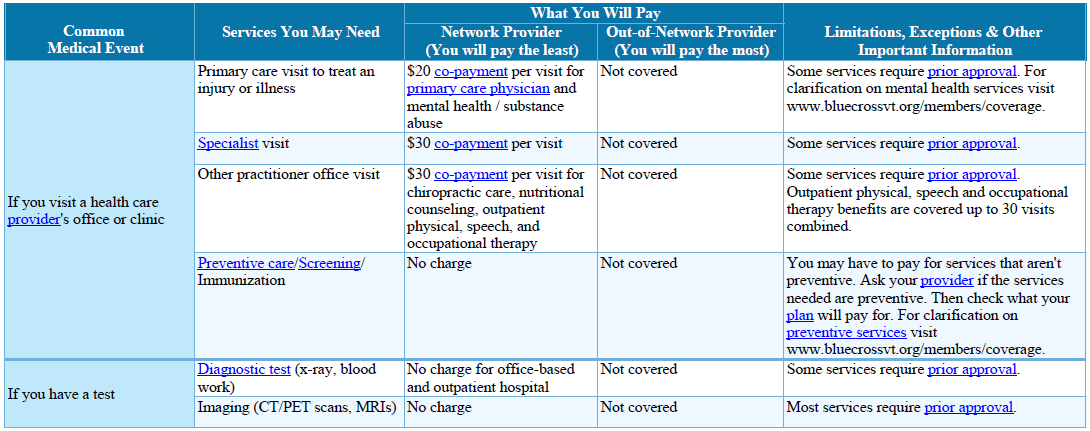
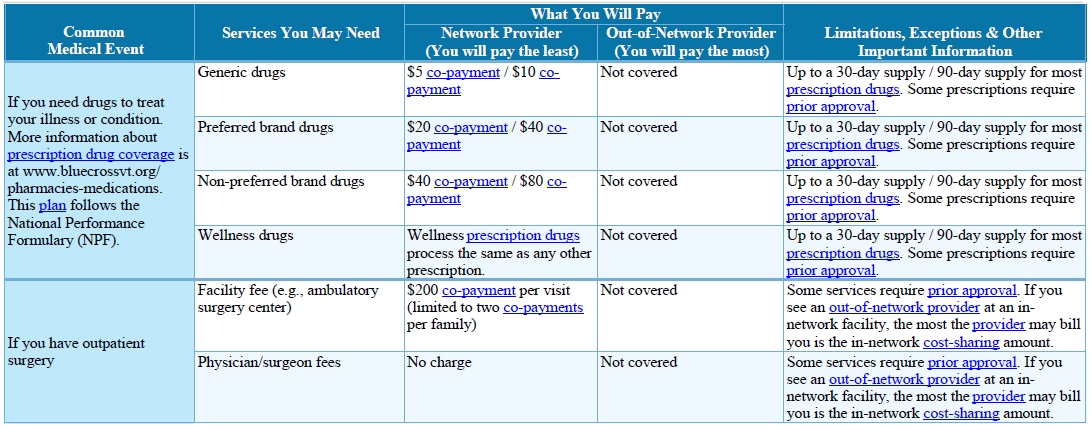
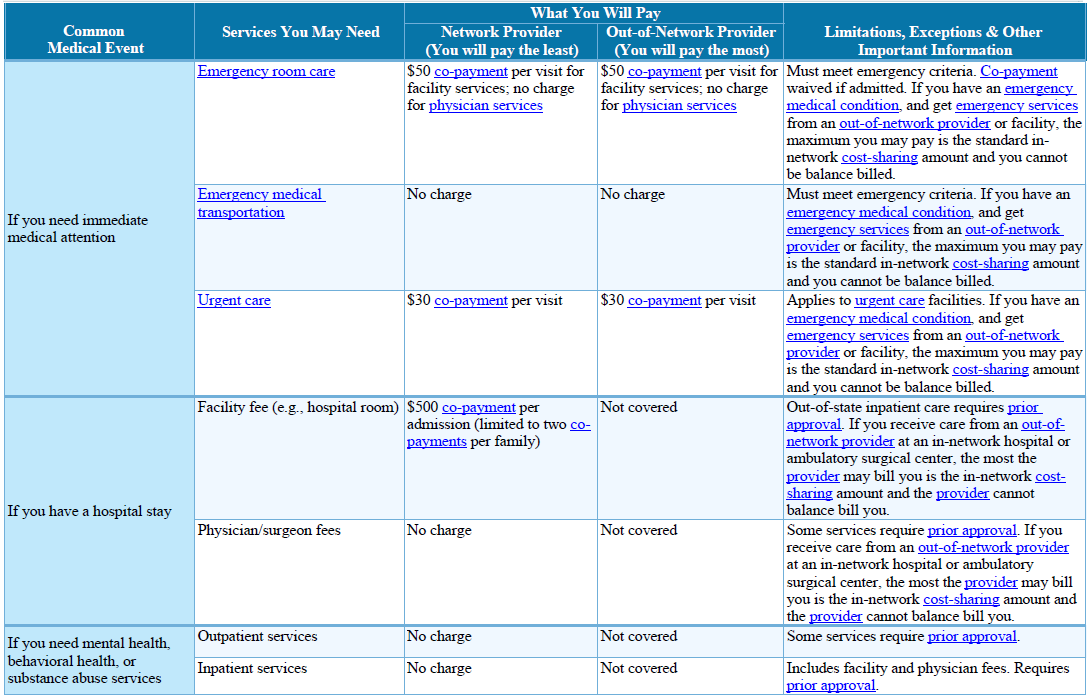


Appendix C-2. Health Plan Outline
| Benefits | In-Network Only |
| Dr. Office Visit | |
| Primary Care Physician/OBGYN | $20 copay |
| Specialists | $30 copay |
| Preventative Care | Covered in full |
| Other Services | |
| X-Ray & Lab (Diagnostic) | 20% coinsurance |
| Outpatient Procedures | 20% coinsurance |
| Inpatient Care | 20% after deductible |
| Emergency Room | $100 copay per visit (waived if admitted) /20% after deductible |
| Ambulance | 20% after deductible |
| Urgent Care | $30 copay |
| Chiropractic Care | $30 copay |
| Retail Prescription Drugs | |
| Rx Deductible | No deductible |
| Generic | $5 copay |
| Preferred Brand | $30 copay |
| Non-Preferred Brand | $50 copay |
| Rx Out of Pocket Maximum | $1,250 / $2,500 |
| Lifetime Maximum | Unlimited |
| Annual Deductible | Stacked Deductible |
| Individual | $200 |
| Family | $600 |
| Out-of-Pocket Maximum | |
| Individual | $1,250 |
| Family | $3,750 |
Appendix D. Dental Plan Outline

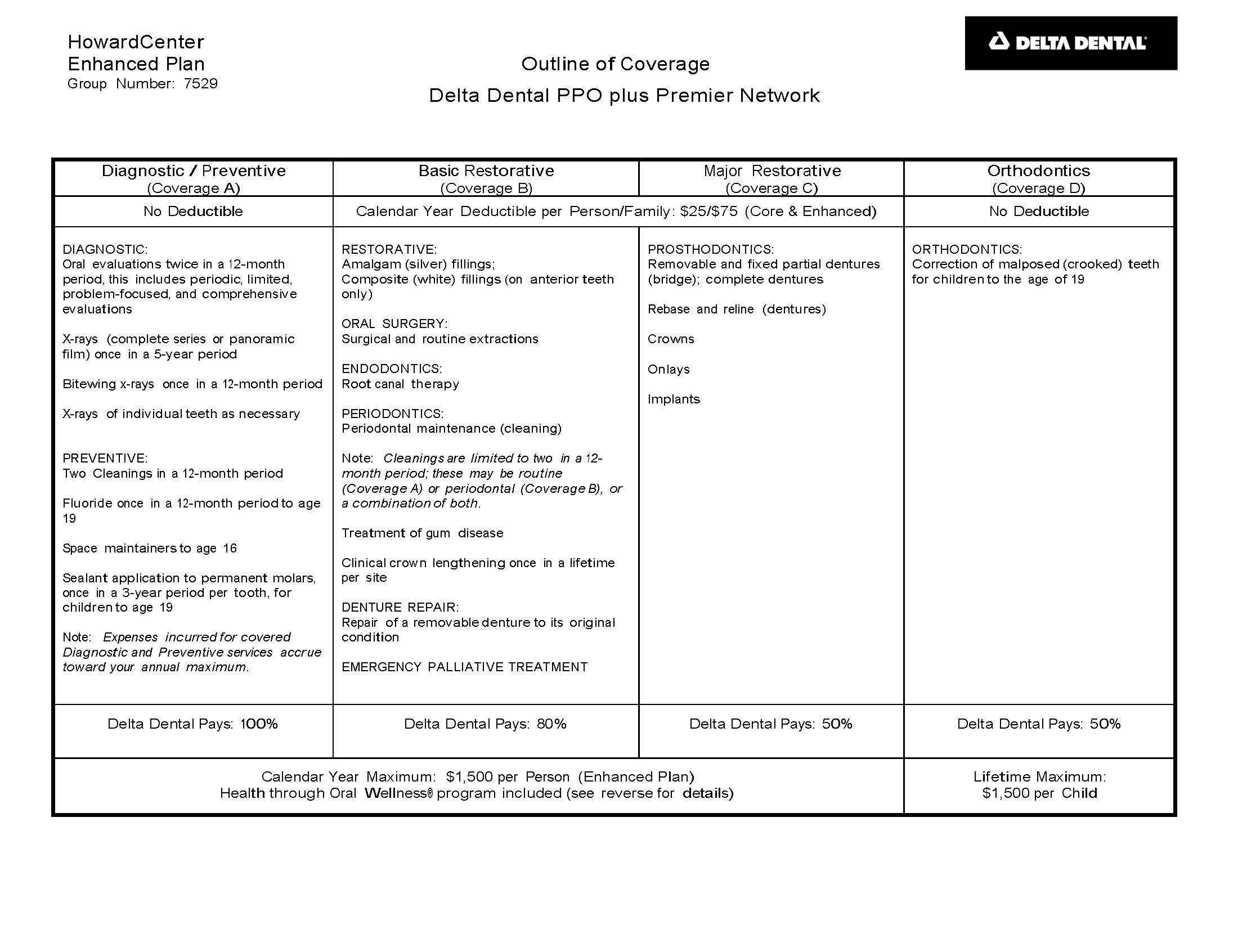
Appendix E. Salary Structure
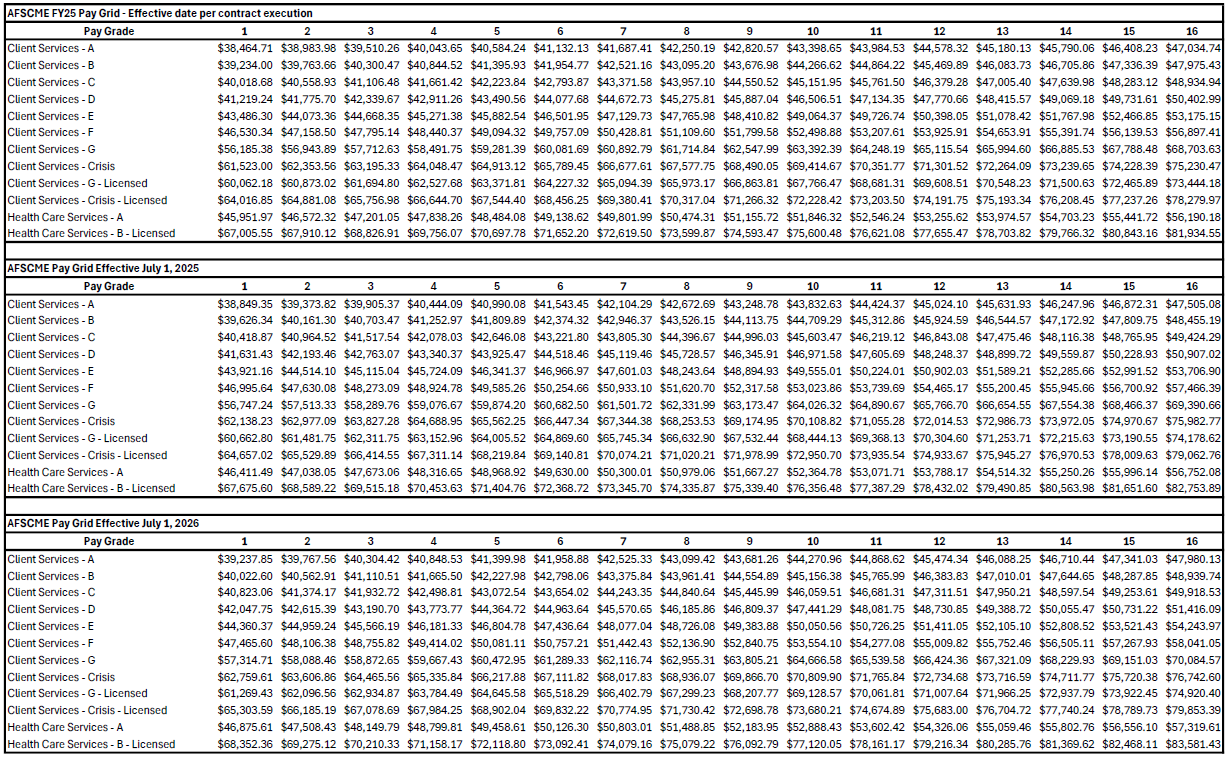
Appendix F. Step Movement Chart
| Complete Years of Service in the Pay Grade as of 6/30 | Step | Step for Positions Starting at Step 4 per Section 501 |
| 0 | 1 | 4 |
| 1 | 2 | 5 |
| 2 | 3 | 6 |
| 3 | 4 | 6 |
| 4 | 5 | 7 |
| 5 | 6 | 7 |
| 6 | 6 | 8 |
| 7 | 7 | 8 |
| 8 | 7 | 9 |
| 9 | 8 | 9 |
| 10 | 8 | 10 |
| 11 | 9 | 10 |
| 12 | 9 | 11 |
| 13 | 10 | 11 |
| 14 | 10 | 12 |
| 15 | 11 | 12 |
| 16 | 11 | 13 |
| 17 | 12 | 13 |
| 18 | 12 | 14 |
| 19 | 13 | 14 |
| 20 | 13 | 15 |
| 21 | 14 | 15 |
| 22 | 14 | 16 |
| 23 | 15 | 16 |
| 24 | 15 | 16 |
| 25 | 16 | 16 |
| 26 | 16 | 16 |
Appendix G. Bargaining Unit Job Titles
Client Services – B
Arts Collective Installation Guide
Arts Collective Open Studio Manager
Arts Collective Outreach and Community Engagement
Developmental Services Peer Mentor
Direct Support Professional
Direct Support Professional – CSP
Job Coach
Peer Specialist
Respite Provider
Client Services – C
Benefits Counselor
Career Coach
Employment Specialist
Interventionist – Community Based – ARCh
Interventionist – Community Based – Early Childhood
Interventionist – Community Based – Enhanced Family Treatment
Interventionist – Community Based – FCBS
Client Services – D
Acute Direct Support Professional
Community Specialist
Residential Counselor Adult – Avenue 7
Residential Counselor Adult – Branches
Residential Counselor Adult – Floater
Residential Counselor Adult – Shelter Plus
Residential Counselor Adult – Spruce Street
Residential Counselor Adult – SUCCEED
Specialized Service Provider
Client Services – E
Access Specialist
Acute Residential Counselor Adult – Crisis Stabilization
Acute Residential Counselor Adult – Allen House
Acute Residential Counselor Adult – Atwood
Acute Residential Counselor Adult – Community Apartments
Acute Residential Counselor Adult – East Terrace
Acute Residential Counselor Adult – Elmwood
Acute Residential Counselor Adult – Floater
Acute Residential Counselor Adult – Lakeview
Acute Residential Counselor Adult – Next Door
Acute Residential Counselor Adult – Pennington
Acute Residential Counselor Adult – Safe Haven
Acute Residential Counselor Adult – Seventy Two
Acute Residential Counselor Youth – 77 Park
Acute Residential Counselor Youth – Jarrett House
Acute Residential Counselor Youth – Transition House
Care Manager – AAP – Chittenden Clinic
Care Manager – AAP – Mental Health Court
Care Manager – AAP – Outpatient FGI
Care Manager – CSP
Care Manager – IFBS
Care Manager – INCLUSION
Care Manager – MHUC
Care Manager – Pine Street
Care Manager – Residential – Transition House
Care Manager – Safe Recovery
Community Mental Health Ambassador
Crisis Coordinator
Housing Coordinator – CSP
Intake Navigator
Interventionist – Residential – Fay Honey Knopp
Interventionist – School Based – ASP
Interventionist – School Based – Baird & Inclusion
Interventionist – School Based – Garvin
Medical Assistant
Multicultural Liaison
Senior Access Specialist
Senior Acute Residential Counselor Youth
Senior Intake Navigator
Senior Interventionist – School Based – ASP
Senior Interventionist – School Based – Inclusion
Client Services – F
Teaching Interventionist – Baird School
Teaching Interventionist – Garvin School
Teaching Interventionist – Inclusion
Client Services – G
Clinician – Access & Intake
Clinician – ARCh
Clinician – Childrens Outpatient
Clinician – Chittenden Clinic
Clinician – Crisis Stabilization
Clinician – DS Outpatient
Clinician – Early Childhood
Clinician – Enhanced Family Treatment
Clinician – FCBS
Clinician – FCP
Clinician – HC North
Clinician – IFBS
Clinician – Jarrett
Clinician – JOBS
Clinician – Pine Street
Clinician – Residential – Park Street
Clinician – Residential – Transition House
Clinician – Safe Recovery
Clinician – School Programs – Baird School
Clinician – School Programs – Garvin
Clinician – School Programs – Outpatient
Clinician – School Programs – School Services
Clinician – Treatment Courts
Crisis Clinician – FCCC
Crisis Clinician – MHUC
Military Outreach Clinician
Senior Clinician – Chittenden Clinic
Senior Clinician – School Programs – Baird School
Senior Crisis Clinician – FCCC
Health Care Service – A
LPN
Health Care Services – B
Registered Nurse
Registered Nurse – MOUD
Appendix H. School Based Clinicians Contract Variations
School based clinicians shall have all rights as noted within this Agreement as co-hires with the following modifications:
- The work year shall be for a total of 205 days to be worked out with the co-employer.
- Employees in this title shall be eligible for paid sick leave up to eight (8) days per year and three (3) personal leave days per year. Such leave shall not accrue from year to year beyond 15 days of sick time.
- CTO or vacation time under this Agreement shall not apply to employees in this title.
- Emergency school closings such as snow days shall be time off with pay.
- Accrued CTO time shall be used by August 15, 1998 or otherwise paid to the employee upon leaving employment.
- The work day shall be eight (8) hours.
- Employees in this title shall be paid at the appropriate step in a grade 10 over twelve (12) months.
- Part time employees shall receive all benefits as noted on a pro-rated basis.
- Employees who upon fulfilling the conditions of the annual contract will be entitled to receive a stipend of $1,000 (prorated if the job is less than full-time).
The agency shall make a good faith effort to have inserted into all contracts with each individual school or school district that, after two years of employment in the same school in the same position, the just cause provisions of this agreement will apply to the SBC so employed for performance-based reasons.
A side letter will be written so that the Agency will endeavor to ask co-employers to avoid using clinicians for recess, lunch duty, study hall and other similar duties, unless the clinician desires to perform such duties as a part of their work.
Appendix I. Clinician—Baird School Contract Variations
Clinicians—BAIRD School shall have all rights as noted within this Agreement with the following modifications:
- Clinicians – BAIRD School shall share the same annual calendar including summer session for a total of 205 work days.
- Employees in this title shall be eligible for paid sick leave up to eight (8) days per year and three (3) personal leave days per year. Such leave shall not accrue from year to year beyond 15 days of sick time.
- CTO under this Agreement shall not apply to employees in this title.
- The work day shall be eight (8) hours.
- Employees will be paid additional compensation at their regular rate of pay for all approved in advance hours worked outside of their school calendar schedule.
- Employees who upon fulfilling the conditions of the annual contract will be entitled to receive a stipend of $1,000 (prorated if the job is less than full-time).
Appendix J. School Based Interventionist Contract Variations
As soon as the same can be implemented in an orderly administrative manner, but no later than January 31, 2025, the revised work schedule/work year for school-based interventionists shall be implemented in accordance with this Appendix J.
School Based Interventionists (includes Interventionist – School Based, Senior Interventionist – School Based, and Teaching Interventionist) shall have all the rights of this agreement with the following modifications:
1. The work year shall consist of 217 days in a 12-month period with the Agency determining the schedule.
2. The work year shall include school days, summer program, and in-service training days.
3. School Based Interventionists shall accrue CTO at a rate of 12 days per year (pro-rated for part-time) with a cap of 210 hours.
4. With supervisory approval CTO will be deducted for the following purposes:
4. (a) Personal leave, with the following conditions:
4. (a) a. Use of CTO for personal leave is limited to 4 days per school year
4. (a) b. Personal leave requires at least 48 hours’ notice or more where possible
4. (b) Extended bereavement leave
4. (c) Sick leave can be used for the following reasons:
4. (c) i) The employee is ill or injured.
4. (c) ii) The employee obtains professional diagnostic, preventive, routine, or therapeutic health care.
4. (c) iii) The employee cares for a sick or injured parent, grandparent, spouse, child, sibling, parent-in-law, grandchild, or foster child, including helping that individual obtain diagnostic, preventive, routine, or therapeutic health treatment, or accompanying the employee’s parent, grandparent, spouse, or parent-in-law to an appointment related to their long-term care.
4. (c) iv) The employee is arranging for social or legal services or obtaining medical care or counseling for the employee or for the employee’s parent, grandparent, spouse, child, sibling, parent-in-law, grandchild, or foster child, who is a victim of domestic violence, sexual assault, or stalking or who is relocating as the result of domestic violence, sexual assault, or stalking. As used in this section, “domestic violence,” “sexual assault,” and “stalking” shall have the same meanings as in 15 V.S.A. § 1151.
4. (c) v) The employee cares for a parent, grandparent, spouse, child, sibling, parent-in-law, grandchild, or foster child, because the school or business where that individual is normally located during the employee’s workday is closed for public health or safety reasons.
5. Observed holidays shall be recorded under the same time off code used when school is not in session.
6. Emergency school closings such as snow days may be a work day with a different student whose school remains open, or be time off with pay using the time off code for when school is not in session. If the day had already been requested under personal or sick time it will remain under the requested time off code.
7. Article VI (Time Off) shall apply to School Based Interventionists, except for paragraphs of this Appendix that contradict the sections of the article.
8. The workday shall be seven and a half (7.5) hours.
9. School Based Interventionists shall be paid over twelve (12) months.
Appendix K. Grievance Form
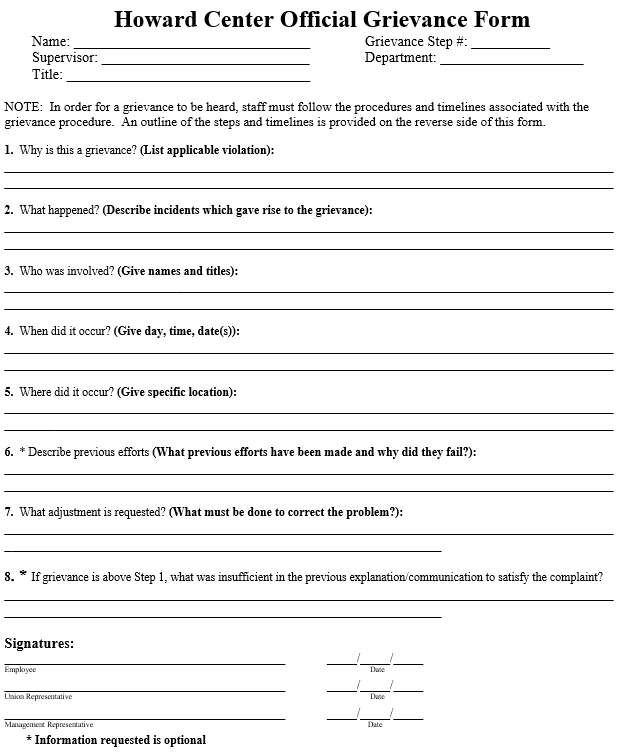
 AFSCME Local #1674